What this STM32L4 MCU brings to a BOM
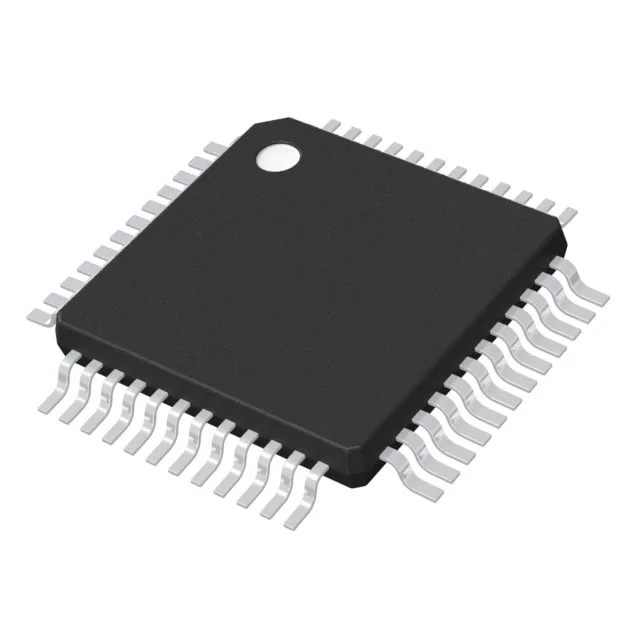
It targets applications where a balance of processing throughput — including DSP and floating-point instructions — and low active/standby current is needed: industrial sensors, portable medical devices, metering, and IoT edge nodes that run on battery or energy-harvesting supplies. The 48-LQFP package keeps the board footprint compact while leaving 38 I/O accessible for sensor interfaces, display segments, or control loops.
If you are coming from an STM32L1 (Cortex-M3 at 32 MHz), this part roughly doubles the arithmetic throughput per cycle on top of the clock increase — useful for FFT-based vibration analysis or closed-loop motor current regulation. The flash wait state needs to be set to 1 when the system clock exceeds about 32 MHz, or the first branch after a cache miss will hard-fault. Keep that in the bring-up checklist.
Memory sizing for the firmware engineer
The Flash is enough for a FreeRTOS kernel, a USB stack, and a modest application image with room for OTA staging if you use the 2 KB page erase granularity. The 64 KB SRAM splits across a main SRAM (48 KB) and a retained SRAM2 (16 KB) that survives Stop modes — useful for keeping calibration data or a comms buffer alive without waking the core.
Connectivity and peripherals for system integration
The peripheral set includes CANbus, USB (device and OTG), QSPI for external memory expansion, SAI for audio codec interfaces, and multiple I²C/SPI/UART channels. The 10x12-bit SAR ADC with hardware oversampling and two 12-bit DACs cover analog front-end needs without external converters. The LCD controller drives up to 8x40 segments directly — a feature that saves a segment driver IC in display-based designs.
Package and handling for the rework bench
No hidden balls, no X-ray needed. If the part comes from Tape & Reel (the TR suffix), the moisture sensitivity level is typically MSL 3 — bake at 125°C for 48 hours if the sealed bag has been open longer than the floor-life window. The orientation is unambiguous: pin 1 chamfer at the top-left when the part is placed with the text readable.
For new designs, the STM32L4 series is still the recommended ultra-low-power platform from ST, so roadmap risk is low.