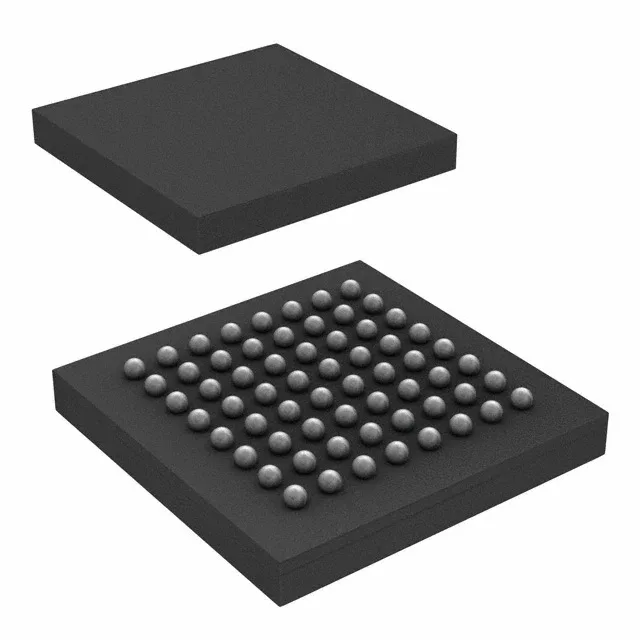
80 MHz Cortex-M4 in a 5x5 mm BGA — what that buys the firmware
The STM32L431RCI6: ARM Cortex-M4 core with FPU, clocked at 80 MHz. The 64-UFBGA package measures 5x5 mm.
Peripheral set — CANbus, QSPI, and the rest
This MCU carries CANbus (2.0B active), QSPI (for external Flash or RAM), SAI (audio serial interface), and SWPMI (single-wire protocol). That CANbus interface is the key differentiator versus the STM32L0 or STM32L1 families — if your BOM needs a CAN node, this part saves an external CAN transceiver controller. The QSPI lets you memory-map external Flash for code shadowing or data logging without bit-banging. The 52 I/O lines are available in the 64-ball UFBGA, with most multiplexed to the usual STM32L4 peripherals: multiple SPI, I2C, UART/USART, and a 16-channel 12-bit ADC plus two 12-bit DACs. Brown-out detect, DMA, and PWM are standard.
Lifecycle and BOM commitment
The base product number STM32L431 is a current-production family, so toolchain and documentation support are mature. For dual-sourcing resilience, note that the STM32L151CBU6A (Cortex-M3, 32 MHz, fewer peripherals) is a different architecture — not a pin-compatible second source, but a functional alternative if your firmware can be ported down.