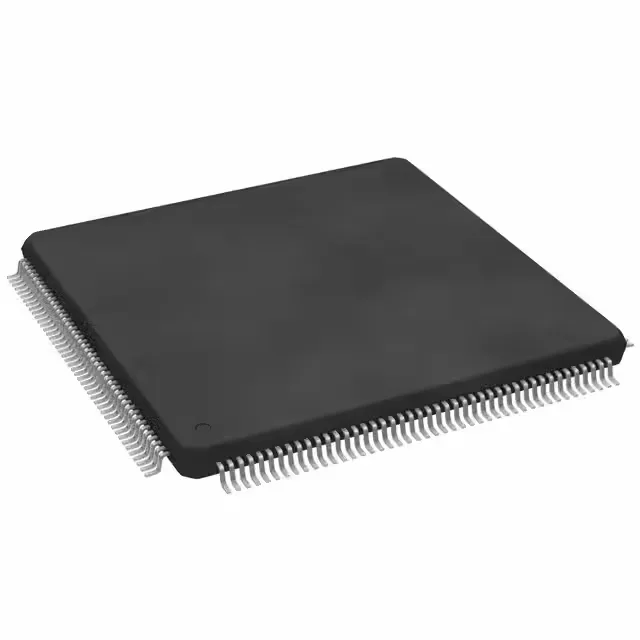
The STM32H7B3IIT6Q: 2 MB of Flash and 1.4 MB of SRAM. 176-LQFP package with 119 I/O.
At 280 MHz, this core can handle real-time control loops, audio processing, or graphics rendering without breaking a sweat. The Cortex-M7 includes a double-precision FPU and a cache architecture that keeps the pipeline fed from the 2 MB Flash. If you are coming from a lower-speed MCU, budget for flash wait states at this clock — the datasheet's memory configuration table tells you how many cycles to insert per access at 280 MHz to avoid hard faults on branch-heavy code.
2 MB of Flash and 1.4 MB of SRAM. Base product number STM32H7B3.
Connectivity and peripherals at a glance
The peripheral set covers the major interfaces you would expect on a high-end MCU: dual CANbus, USB OTG, multiple SPI and I2C, SAI for audio, SPDIF, and a camera interface. The EBI/EMI bus lets you attach external SRAM, NOR Flash, or an FPGA without a separate bridge. The LCD controller with the built-in DMA engine can drive a display without loading the CPU. For industrial designs, the brown-out detect and POR keep the system from running on a glitchy supply.
176-LQFP (24x24 mm) surface-mount package. Supply voltage range 1.62 V to 3.6 V.