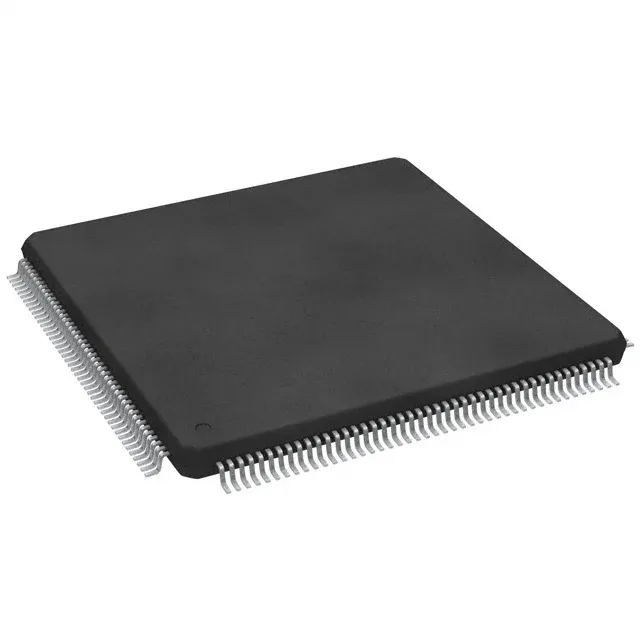
STMicroelectronics STM32H757IIT6 — Microcontrollers & Processors (MCU / MPU / DSP)

STM32H757IIT6 STM32H7 Dual-Core MCU, 2MB Flash, 176-LQFP

MPNSTM32H757IIT6
Active

STMicroelectronics STM32H7 series, STM32H757IIT6, 32-Bit Dual-Core ARM Cortex-M4/M7, 240MHz/480MHz, 2MB Flash, 1M x 8 RAM, 119 I/O, 176-LQFP, -40°C to 85°C.

$20.2900Ref. price · indicative, final on quote
Packaging176-LQFP
RoHSROHS3 Compliant
SeriesSTM32H7
Independent supplier — new & surplus stockAuthenticity-screened · ESD-safe packingListing updated Aug 2026

Specifications

STM32H757IIT6 specifications
ParameterValue
SeriesSTM32H7
MountingSurface Mount
Oscillator typeInternal
Program memory typeFLASH
Voltage - supply (Vcc (Vdd))1.62V ~ 3.6V
Operating temperature-40°C ~ 85°C (TA)
Speed240MHz, 480MHz
PackageTray
RAM size1M x 8
Core size32-Bit Dual-Core
PeripheralsBrown-out Detect/Reset, DMA, I²S, LCD, POR, PWM, WDT
ConnectivityCANbus, EBI/EMI, Ethernet, I²C, IrDA, LINbus, MDIO, MMC/SD/SDIO, QSPI, SAI, SPDIF, SPI, SWPMI, UART/USART, USB OTG
Number of i (O)119
Core processorARM® Cortex®-M4/M7
Case176-LQFP
Data convertersA/D 28x16b; D/A 2x12b
Program memory size2MB (2M x 8)

Product details

Dual-core Cortex-M4/M7: one chip, two speed domains

The STM32H757IIT6 is STMicroelectronics' dual-core workhorse in the STM32H7 series, pairing an ARM Cortex-M7 running at 480 MHz with a Cortex-M4 at 240 MHz on a single die. This asymmetric architecture lets you offload real-time control loops or communications stacks to the M4 while the M7 handles number-crunching or graphics — without a second MCU on the BOM. The 2 MB Flash and 1 MB SRAM give enough headroom for a combined application: a complex motor-control algorithm on the M7 and a fieldbus stack on the M4, for instance.

Connectivity for industrial gateways and edge nodes

With Ethernet, dual CANbus, USB OTG, QSPI, and SAI on the peripheral list, this MCU is sized for a gateway or industrial controller that needs to bridge fieldbus, sensor networks, and a cloud uplink. The 119 I/O in the 176-LQFP package leave room for parallel memory or an external display without a port expander. The data-converter set — 28x16-bit ADC and 2x12-bit DAC — covers multi-channel analog acquisition for motor feedback or sensor arrays.

The 176-LQFP (24x24 mm) is a hand-solderable, inspectable package — no BGA rework station needed — but the 0.5 mm pitch still demands careful PCB routing and a clean solder-paste stencil. The supply range of 1.62 V to 3.6 V covers both 1.8 V and 3.3 V logic families, simplifying the power tree.

Frequently asked questions

What is the difference between STM32H757IIT6 and STM32H743IIT6?

The STM32H757IIT6 is a dual-core device with both a Cortex-M7 at 480 MHz and a Cortex-M4 at 240 MHz, while the STM32H743IIT6 is a single-core Cortex-M7 at 480 MHz. The dual-core variant adds the M4 core for offloading control or communications tasks, at the cost of slightly different power-management dynamics. Both share the same 176-LQFP footprint and much of the peripheral set, but the H757 requires firmware that manages two cores.

Does STM32H757IIT6 support Ethernet and which PHY?

Yes, Ethernet is listed in the connectivity set. The MCU integrates the MAC layer; you need an external PHY chip (e.g., LAN8720A or DP83848) connected via the RMII or MII interface. The specific PHY selection depends on your speed and isolation requirements.

How to program STM32H757IIT6 using ST-Link?

The STM32H757IIT6 has a standard SWD (Serial Wire Debug) interface. Connect ST-Link's SWDIO, SWCLK, and GND to the corresponding MCU pins, plus VDD from the target board. Use STM32CubeProgrammer or any ARM-compatible debugger to flash the 2 MB internal Flash. The boot from internal Flash is selected with BOOT0 strapped low.