What the 170 MHz Cortex-M4 and memory map mean for your control loop
The STM32G473VET3: The 170 MHz clock lets the FPU and DSP instructions chew through a PID loop or a fast Fourier transform without stalling the control thread. The 512 KB program memory is FLASH, so firmware updates are straightforward over the USB or CAN interface. The 128 KB SRAM gives you room for multiple data buffers and a real-time operating system heap without external RAM. If your application needs to log telemetry or run a GUI frame buffer, budget the SRAM against those requirements.
Analog peripherals that replace external components
This MCU carries 42 analog-to-digital converter channels at 12-bit resolution and 7 digital-to-analog converter channels at 12-bit resolution. That many ADC channels means you can sense multiple current phases, voltage rails, and temperature points on a single chip — no external multiplexer needed. The seven DACs are useful for generating analog setpoints or bias voltages in a multi-loop control system. If your timing budget is tight, the internal RC is trimmed to ±1% accuracy over temperature, which is sufficient for UART and most PWM timing.
Connectivity and I/O for a mixed-signal control board
With 86 I/O pins and a connectivity set that includes CANbus, I²C, SPI, QSPI, UART/USART, USB, and SAI, this part can talk to sensors, actuators, displays, and a host controller without glue logic. The QSPI interface is particularly useful for attaching external serial NOR Flash for firmware over-the-air staging or data logging. The PWM timers are high-resolution, suitable for driving MOSFET gates in a switched-mode power supply or a three-phase motor inverter.
Temperature grade and package — where this MCU lives
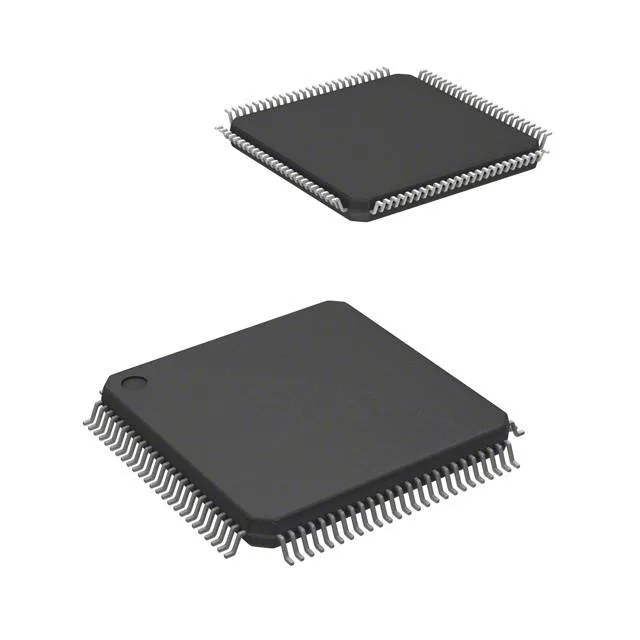
It comes in a 100-pin LQFP package with a 14x14 mm body (100-LQFP). That is a hand-solderable, inspectable package — no BGA rework challenges.
For new designs, this part has a healthy lifecycle runway — ST typically supports G4 series parts for a decade or more.