Cortex-M0+ at 64 MHz — 128 KB flash, 36 KB RAM
The STM32G071CBU7TR: For a firmware engineer: the 64 MHz ceiling sets the throughput limit; the flash wait-state profile at this clock determines how many cycles each instruction actually takes.
An internal oscillator is on-chip, so many designs skip the external crystal entirely, saving two BOM lines and the associated PCB routing.
On-chip ADC and DAC — 17 channels of 12-bit conversion
The data-converter block includes a 17-channel 12-bit successive-approximation ADC and two 12-bit DACs. For a control-loop designer: the 17 analog inputs cover multi-sensor acquisition (current, voltage, temperature) without an external multiplexer; the dual DACs can generate two independent analog setpoints or bias voltages simultaneously. The ADC's 12-bit resolution gives 4096 counts across the reference range — sufficient for most industrial sensor interfaces.
Peripheral set and connectivity
The peripheral list includes DMA, PWM, I²S, and a watchdog timer — the PWM channels handle motor or LED drive, I²S covers digital audio interfaces, and DMA moves data without CPU intervention. For a board designer: the LIN and UART ports talk to automotive and industrial fieldbuses; HDMI-CEC is a consumer-AV control bus, so this MCU can serve in a set-top box or display controller as well as a factory sensor node.
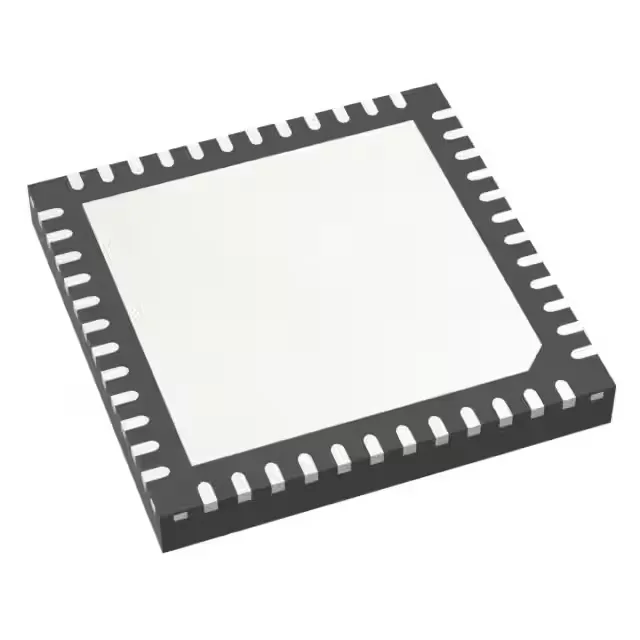
48-UFQFN exposed-pad — board-fit checklist
The package is a 48-lead UFQFN with an exposed pad (7x7 mm body). The 44 GPIOs in a 48-pin package mean almost every pin is usable as I/O; the remaining four pins are power and ground.
STMicroelectronics lists the STM32G071CBU7TR as Active (current production). The base product number is STM32G071, and the tape-and-reel suffix (TR) indicates reel packaging for automated pick-and-place.