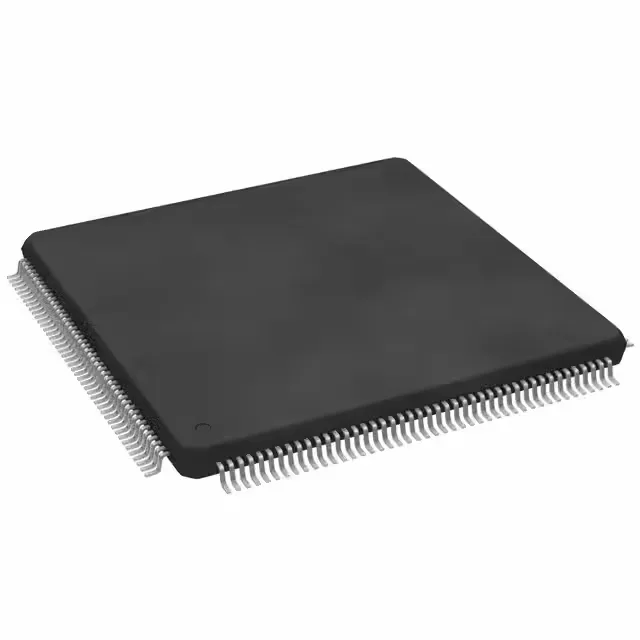
It delivers the DSP and FPU throughput needed for real-time control, audio processing, and communications gateway designs without an external memory bus for code storage. The 216 MHz core speed, combined with the Cortex-M7's single-cycle multiply-accumulate and hardware floating-point unit, gives this part a deterministic compute budget for motor-field-oriented control loops, audio codec pipelines, and protocol-stack processing. The 2 MB Flash density supports large firmware images with OTA update staging, while the 512 KB RAM handles Ethernet TCP/IP buffers, USB descriptor tables, and display framebuffers without external SRAM. Operating temperature spans -40 to 105°C, the industrial-grade range that covers outdoor telecom cabinets, factory-floor motor drives, and under-hood automotive auxiliary modules.
176-LQFP footprint and I/O count
Housed in a 176-LQFP package (24×24 mm body), the STM32F777IIT7 brings out 132 I/O pins. The fine-pitch (0.5 mm) QFP requires a multilayer PCB with dedicated power and ground planes to manage the simultaneous switching noise from the high-speed I/O banks. Decoupling should follow the STM32F7 hardware development guide: one 100 nF ceramic per VDD/VSS pair plus a bulk 4.7 µF to 10 µF on each supply rail. The 132 I/O count, combined with the peripheral multiplexing, allows parallel LCD interfaces, external memory buses (EBI/EMI), and multiple serial ports to coexist. The 24×24 mm package footprint is compatible with standard QFP soldering profiles;
Connectivity: Ethernet, USB OTG, and serial interfaces
The STM32F777IIT7 integrates a 10/100 Ethernet MAC with dedicated DMA and an internal PHY interface (MII/RMII), plus a USB OTG controller that supports host, device, and OTG modes. These two interfaces make this MCU a natural fit for industrial IoT gateways, protocol converters, and edge nodes that bridge fieldbus networks to Ethernet or USB-connected hosts. Additional connectivity includes CANbus, I²C, SPI, UART/USART, SAI (serial audio), SPDIF, QSPI, and SDIO. The QSPI interface can execute code from external Flash at 104 MHz, useful when the 2 MB internal Flash is fully consumed by the application image.
The base product number is STM32F777, which shares pin-compatibility with the STM32F767 series in the same 176-LQFP package. If a design needs to scale memory or peripheral count, the STM32F7 family offers density and feature variants that can drop into the same footprint with firmware adjustments.