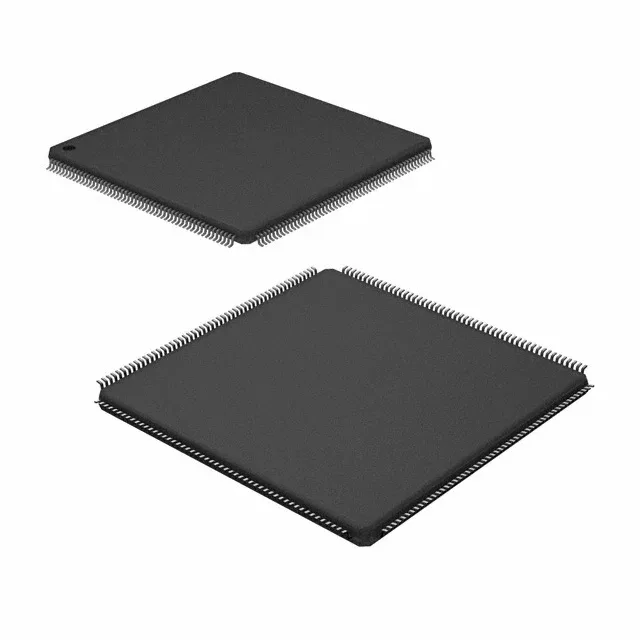
The STM32F777BIT6 is an STMicroelectronics 32-bit ARM Cortex-M7 MCU running at 216 MHz, with 2 MB of Flash and 512 KB of RAM. It sits at the high end of the STM32F7 line — enough memory and peripheral count to handle a Linux-class application processor's workload without the BOM cost of external DDR or NAND. The 208-LQFP package (28x28 mm body) gives access to 159 I/O pins, making it practical for designs that need a parallel display interface, external memory bus, and multiple serial ports simultaneously. Connectivity includes Ethernet MAC, two CAN interfaces, USB OTG HS/FS, multiple SPI/I²C/UART, plus a Quad-SPI interface for memory-mapped external Flash — all on-chip, no external PHY for the Ethernet except the physical-layer transceiver.
216 MHz Cortex-M7 — what the core speed buys you
At 216 MHz the Cortex-M7 delivers roughly 1080 CoreMark points. That puts it ahead of any Cortex-M4 or M3 part in the STM32 portfolio. For a design that runs real-time control loops, audio processing, or a lightweight TCP/IP stack alongside a GUI, this core speed means you don't need a separate DSP or an external MCU for housekeeping. The 2 MB Flash is large enough for dual-image OTA firmware updates — keep a golden image in one half while the application runs from the other. The 512 KB RAM handles Ethernet packet buffers, a display framebuffer at 320x240, and a moderate RTOS heap without external SRAM.
Brown-out detect and POR are integrated, so an external supervisor IC is optional unless you need a precise reset threshold.