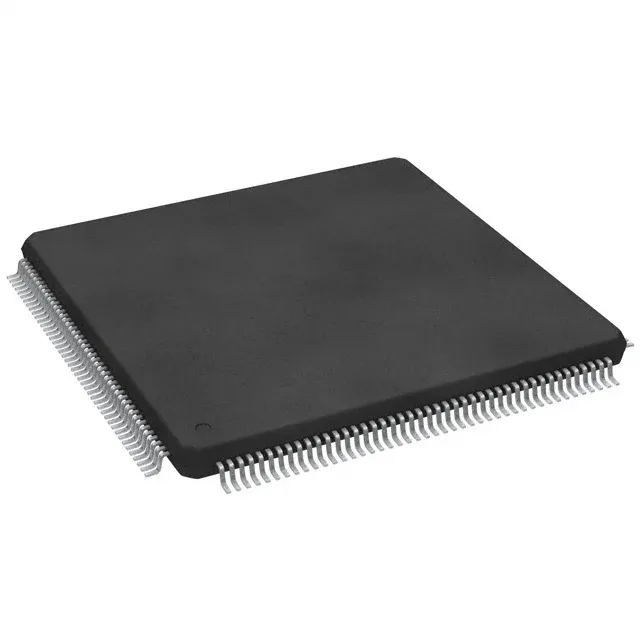
It packs 2 MB of Flash and 512 KB of SRAM, giving firmware teams room for a real-time OS, a GUI library, or a TCP/IP stack without squeezing into a smaller part. The 176-pin LQFP package brings out 140 I/O lines, so you can wire up a parallel LCD, an external memory bus (EBI/EMI), and still have pins left for sensors and actuators. Connectivity covers Ethernet MAC, CAN, USB OTG, Quad-SPI, SAI, SPDIF, and multiple UART/SPI/I²C interfaces — it is designed for the kind of system that bridges a fieldbus to a display and logs data over Ethernet.
Active lifecycle — no last-time-buy scramble
If you are building a BOM that needs to stay stable for a multi-year product, this is a safer pick than an NRND or phase-out part.
That includes factory-floor controllers, outdoor gateways, and engine-bay-adjacent electronics that see cold starts and hot afternoons.
The 176-LQFP (24x24 mm body) is a hand-solderable and inspectable package — no BGA rework station needed. That matters for prototyping, rework, and low-volume production where you cannot justify X-ray inspection.