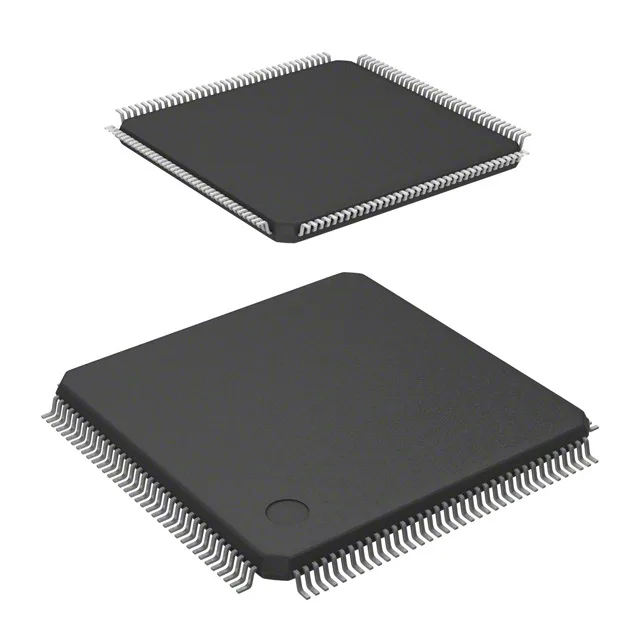
What the 216 MHz Cortex-M7 buys you on the BOM
That core speed and memory pairing puts it in the performance tier for real-time motor control, industrial Ethernet gateways, and audio DSP pipelines where you'd otherwise need a separate FPGA or external SRAM. The 144-LQFP package keeps rework straightforward — no BGA inspection, no X-ray — and the 114 I/O count gives you room for a parallel display bus, external memory interface (EBI/EMI), and a handful of sensors without a port expander.
Peripheral set that saves board space
Built-in Ethernet MAC, dual CAN, USB OTG, Quad-SPI, and a dozen serial interfaces mean most designs skip external PHY or bridge chips. Brown-out detect and POR are integrated, so the external supervisor IC is optional — just a decoupling cap on each supply pair and a clean reset.
That's the green light for new designs and production ramps. For BOM lines that need dual-source confidence, note that the STM32F7 family has no direct second-source from another manufacturer — the STM32L151CBU6A is a different core (Cortex-M3 at 32 MHz) and a smaller package, not a pin-compatible alternate.