216 MHz Cortex-M7 — what that core speed buys you
That core speed, combined with the single-cycle multiply-accumulate and double-precision FPU, puts it in the tier for real-time motor control, audio processing, and protocol bridging where you need deterministic throughput without an external DSP. With 2 MB of Flash and 512 KB of SRAM, the memory budget is generous enough to hold a full TCP/IP stack, a FreeRTOS image, and a few hundred kilobytes of frame buffers or audio samples without external memory. The 168 GPIOs and the peripheral set — Ethernet MAC, dual CAN, USB OTG HS/FS, multiple SPI/I²C/UART, plus a Quad-SPI interface — make this a single-chip node for industrial gateways, PLCs, and vision systems.
216-TFBGA — the footprint reality
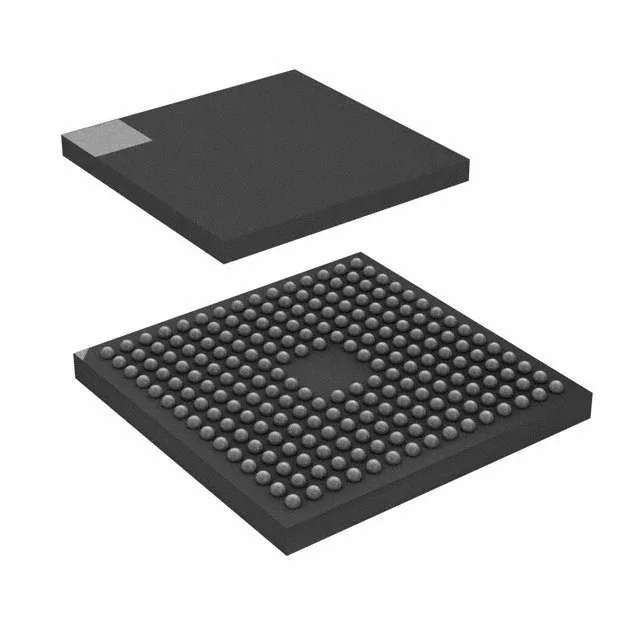
The package is a 216-ball TFBGA, 13x13 mm body. That is a fine-pitch BGA — expect 0.5 mm or 0.65 mm ball pitch, which means blind vias and a multi-layer PCB stackup. The exposed thermal pad needs a via-stitch pattern under the die to pull heat into the inner ground planes; without it, the junction climbs fast above 400 mA continuous core current.