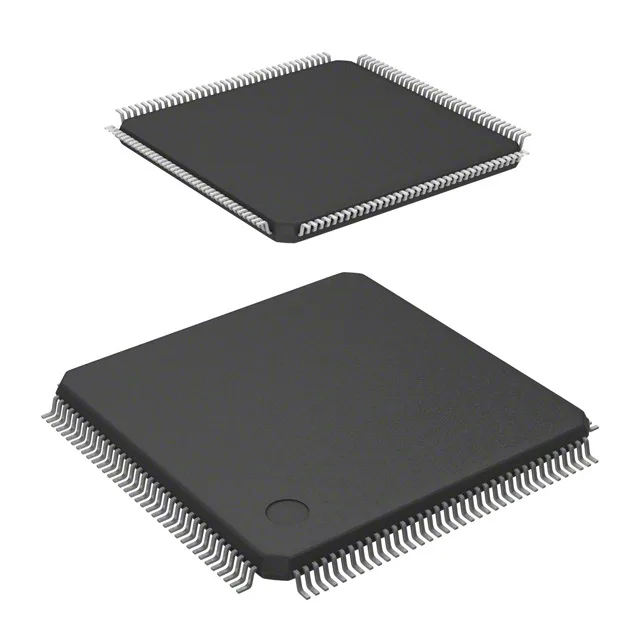
STM32F745ZGT7 STMicroelectronics MCU, 216MHz Cortex-M7, 1MB Flash, 144-LQFP
STMicroelectronics STM32F7 series, ARM Cortex-M7 32-bit MCU running at 216MHz, 1MB Flash / 320KB SRAM, 144-LQFP tray, 114 I/O, 1.7–3.6 V supply, -40 to 105°C, integrated Ethernet MAC, 24-ch 12-bit ADC.
Specifications
| Parameter | Value |
|---|---|
| Series | STM32F7 |
| Mounting | Surface Mount |
| Oscillator type | Internal |
| Program memory type | FLASH |
| Voltage - supply (Vcc (Vdd)) | 1.7V ~ 3.6V |
| Operating temperature | -40°C ~ 105°C (TA) |
| Speed | 216MHz |
| Package | Tray |
| RAM size | 320K x 8 |
| Core size | 32-Bit Single-Core |
| Peripherals | Brown-out Detect/Reset, DMA, I²S, POR, PWM, WDT |
| Connectivity | CANbus, EBI/EMI, Ethernet, I²C, IrDA, LINbus, SAI, SD, SPDIF-Rx, SPI, UART/USART, USB OTG |
| Number of i (O) | 114 |
| Core processor | ARM® Cortex®-M7 |
| Case | 144-LQFP |
| Data converters | A/D 24x12b; D/A 2x12b |
| Program memory size | 1MB (1M x 8) |
Frequently asked questions
Can I run the STM32F745ZGT7 at 216MHz in a sealed panel at 85°C ambient without thermal derating?
The rated ambient ceiling is 105°C, but the actual junction temperature depends on the on-chip power dissipation at full core load. A sealed panel with restricted airflow reduces thermal headroom compared to the datasheet's test conditions. Verify the design's estimated junction temperature against ST's junction-to-ambient thermal resistance data for the 144-LQFP with and without the exposed pad soldered.
Does the STM32F745ZGT7 require an external PHY for Ethernet, and which speed class does it support?
The part integrates a 10/100 Ethernet MAC with an RMII interface — an external RMII PHY is required to complete the physical layer. The MAC supports 100 Mbps full-duplex; timestamping hardware is present on-die for industrial Ethernet protocols. Confirm your protocol stack's timing class requirements against the MAC's RMII timing constraints.