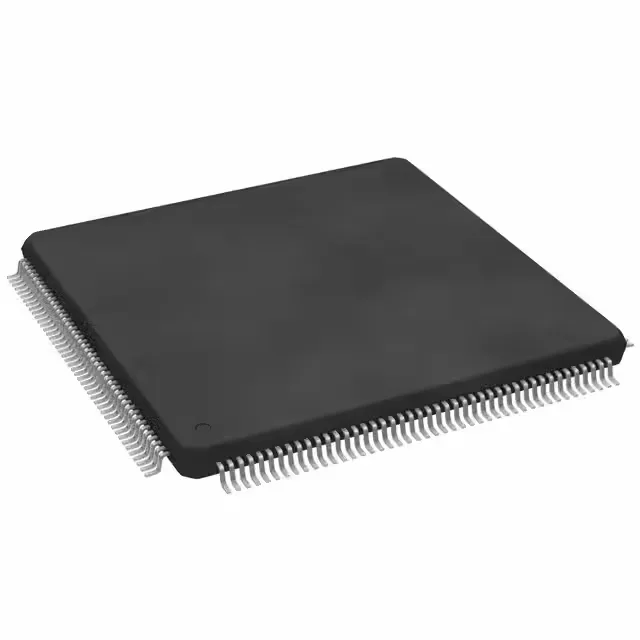
What this STM32F745IET6 brings to the board
The 140 I/O pins break out through a 176-LQFP package (24x24 mm body), which is large enough for hand-inspection and rework with a hot-air station. This part targets applications that need a single-chip controller with wired connectivity: Ethernet for industrial networking, CANbus for vehicle or machine buses, and USB OTG for device-to-host links.
The 216 MHz core clock puts the STM32F745IET6 in the performance tier for Cortex-M7 parts. That clock rate supports DSP instructions and a single-precision FPU, so the chip can run FFTs, motor-control observers, or audio processing without a separate DSP. The flash wait states need configuring when you push past 48 MHz on the PLL — the boot code should set at least one wait state before raising the system clock, or the first instruction fetch hard-faults.
Memory budget for firmware and data
512 KB of Flash is enough for a full RTOS, a TCP/IP stack with Ethernet driver, and a CANopen or Modbus application layer. The 320 KB SRAM splits across multiple blocks — the core can run code from the tightly-coupled memory (DTCM/ITCM) for zero-wait-state execution at 216 MHz. If your application uses a camera sensor or large audio buffers, check whether the SRAM budget covers the frame or sample storage before you commit the BOM.
For indoor or sheltered installations the temperature margin is generous.
Supply rails and power-up sequence
Brown-out detect and POR are integrated, so the reset circuit can be a simple RC network or a supervisor if you need tighter threshold accuracy. The internal oscillator means the chip can run without an external crystal for non-timing-critical applications, though Ethernet and USB will want an external clock source.
176-LQFP with a 24x24 mm body and 0.5 mm pitch. The package is inspectable and reworkable with standard hot-air tools, which keeps the repair bench happy.