The 216 MHz core with DSP instructions and single-precision FPU handles real-time control loops, audio processing, and sensor fusion without an external DSP.
Memory sizing — 256 KB Flash, 256 KB RAM
The 256 KB Flash and 256 KB RAM are balanced for firmware that holds moderate code size with a large data buffer — think Ethernet packet queues, audio sample buffers, or dual-image OTA staging. If your application needs more than 256 KB of code space, step up to the STM32F722's higher-density siblings in the same 144-LQFP footprint.
Connectivity and analog — one chip, many buses
This MCU integrates CANbus, USB, QSPI, SAI (serial audio interface), and multiple I²C/SPI/UART channels — enough to connect to a CANopen fieldbus, a QSPI NOR Flash for code shadowing, an audio codec via SAI, and a USB virtual COM port for debug, all without external bridge chips. The 114 I/O count in the 144-LQFP package leaves plenty of pins for parallel LCDs, external memory buses, or custom FPGA glue logic.
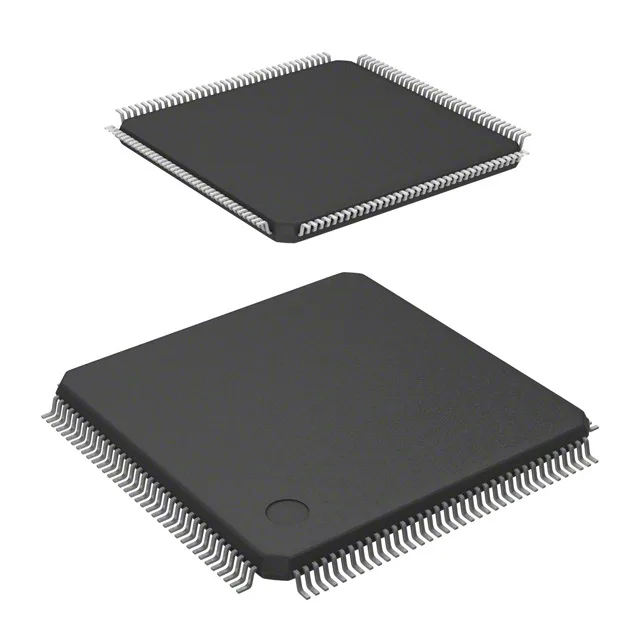
Package and rework — 144-LQFP (20x20 mm)
The 144-LQFP with 0.5 mm pitch and a 20x20 mm body is a hand-solderable package — no hot-air rework station required for a single board. The exposed pad is on the bottom; a thermal via stitch under the pad keeps the junction cool at high core loads.