216 MHz Cortex-M7 with DSP and FPU — what the core speed buys you
That core speed places it in the performance tier for real-time control loops, sensor fusion, audio processing, and communications protocol handling where a conventional Cortex-M4 or M3 would run out of headroom. The 512 KB Flash and 256 KB RAM give enough room for a FreeRTOS application with a TCP/IP stack and a modest GUI frame buffer without external memory.
140 I/O and peripheral mix — what connects where
With 140 I/O lines brought out to a 176-LQFP package, this MCU can serve as the system controller for a board that needs parallel bus interfaces (EBI/EMI), multiple serial channels, and plenty of GPIO for panel buttons, LEDs, and status lines. The connectivity list includes CANbus, USB OTG, multiple SPI and I²C ports, SAI for audio, QSPI for external Flash, and SDIO for SD cards.
176-LQFP footprint — layout considerations
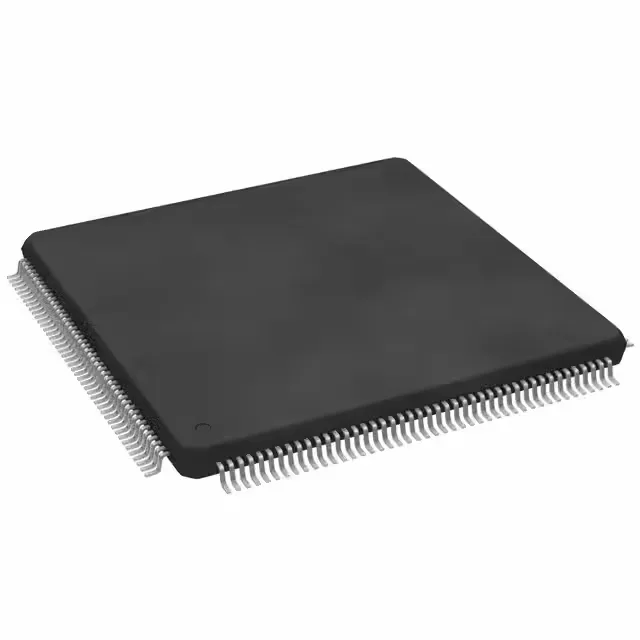
The 176-LQFP package measures 24 mm x 24 mm with a 0.5 mm pitch. That is a standard quad flat pack that two-layer boards can route with careful fan-out, though a four-layer stack-up with a dedicated ground and power plane makes signal integrity easier at 216 MHz.