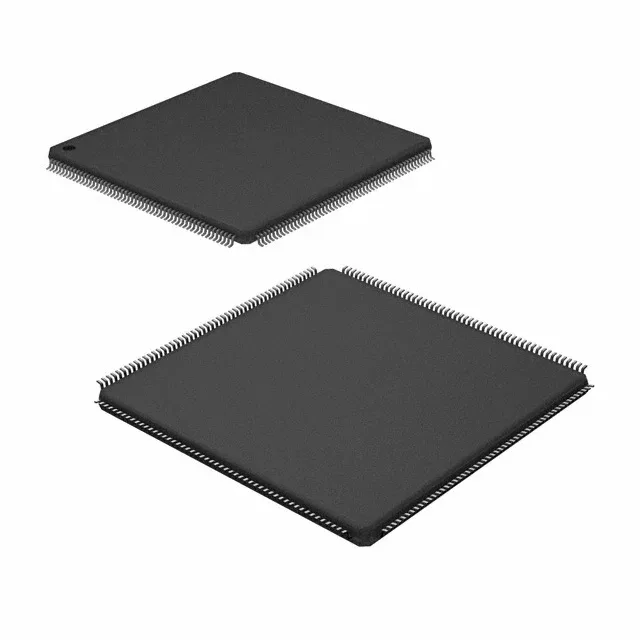
STMicroelectronics STM32F479BIT6 — Microcontrollers & Processors (MCU / MPU / DSP)

STM32F479BIT6 STM32F4 ARM Cortex-M4 MCU, 180MHz, 2MB Flash

MPNSTM32F479BIT6
End of Life

STMicroelectronics STM32F4 series, 32-bit ARM Cortex-M4 single-core at 180MHz, 2MB Flash, 384KB RAM, 161 I/O, Ethernet MAC, USB OTG, CAN, 24x12b ADC/2x12b DAC, 1.7–3.6V supply, -40°C to 85°C, 208-LQFP (28x28mm) tray.

$20.2900Ref. price · indicative, final on quote
Independent supplier — new & surplus stockAuthenticity-screened · ESD-safe packingListing updated Jul 2026

Specifications

STM32F479BIT6 specifications
ParameterValue
SeriesSTM32F4
MountingSurface Mount
Oscillator typeInternal
Program memory typeFLASH
Voltage - supply (Vcc (Vdd))1.7V ~ 3.6V
Operating temperature-40°C ~ 85°C (TA)
Speed180MHz
PackageTray
RAM size384K x 8
Core size32-Bit Single-Core
PeripheralsBrown-out Detect/Reset, DMA, I²S, LCD, POR, PWM, WDT
ConnectivityCANbus, EBI/EMI, Ethernet, I²C, IrDA, LINbus, SAI, SDIO, SPI, UART/USART, USB, USB OTG
Number of i (O)161
Core processorARM® Cortex®-M4
Case208-LQFP
Data convertersA/D 24x12b; D/A 2x12b
Program memory size2MB (2M x 8)

Product details

180 MHz Cortex-M4 with 2 MB Flash — the compute and memory budget

The STM32F479BIT6 runs at 180 MHz with 2 MB Flash and 384 KB RAM.

Ethernet, USB OTG, CAN — the connectivity set for a system-on-chip

This part integrates an Ethernet MAC, dual USB OTG (host/device), three CAN 2.0B interfaces, and a full complement of SPI, I²C, UART, and SAI serial audio interfaces. For a design that needs to bridge a CAN-based sensor network to an Ethernet backbone and serve a web interface over USB, the STM32F479BIT6 handles all three physical layers without external controllers. The 161 general-purpose I/O lines, mapped across the 208-LQFP package, provide enough pins to drive a parallel TFT LCD (via the built-in LCD controller), read a 24-channel 12-bit ADC, and still leave room for a memory-mapped EBI/EMI bus to external SRAM or NOR Flash.

208-LQFP footprint — board area and routing

That is a large, hand-solderable QFP — no BGA reflow required, but the board area commitment is about 784 mm². The 161 I/O signals will need at least a 4-layer PCB to route cleanly, especially when the Ethernet RMII and USB differential pairs are in the mix.

Frequently asked questions

What is the maximum operating frequency of STM32F479BIT6?

The core runs at 180 MHz. At this speed, the Flash memory requires one wait state for zero-wait access; the ART Accelerator in the STM32F4 series handles most instruction fetches from Flash without penalty for typical code.

Does STM32F479BIT6 support Ethernet and USB OTG?

Yes, the connectivity set includes an Ethernet MAC (MII/RMII), dual USB OTG (full-speed and high-speed with on-chip PHY for FS), three CAN 2.0B interfaces, plus SPI, I²C, UART, SAI, and SDIO.