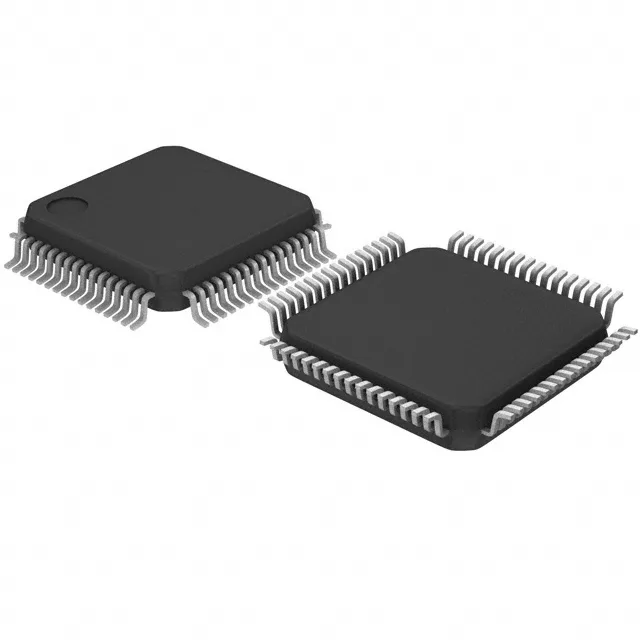
The 64-pin LQFP package gives you 50 general-purpose I/O, plus a rich peripheral set that includes dual CAN 2.0B, full-speed USB OTG, an SPDIF-Rx interface, and a 12-bit ADC with 16 channels. This is a mid-density STM32F4 part aimed at motor drives, audio processing, and industrial communication nodes where the 180 MHz ceiling and FPU throughput justify the step up from the STM32F1 or F3 families.
The internal oscillator is rated, but if you need better than a few percent accuracy over temperature, plan to feed the HSE pins with an external crystal or oscillator. The 64-LQFP package has a 10x10 mm body with 0.5 mm pitch — standard for hand-assembly and reflow, but verify the footprint matches your solder-paste stencil aperture for the exposed pad if your layout uses it for thermal relief.
What the TR suffix changes — and what it does not
The STM32F446RCT6 and STM32F446RCT6TR are electrically identical — same 180 MHz Cortex-M4, same 256 KB Flash, same 64-LQFP package. The only difference is the shipping medium: the TR variant comes on 13-inch tape-and-reel, while the base code without the suffix ships in tray or tube. If your assembly line feeds from reels, order the TR suffix; if you prototype by hand or use a tube feeder, the tray version avoids repackaging. No difference in firmware, pinout, or temperature grade.