180 MHz Cortex-M4 with 2 MB Flash — the HMI and gateway workhorse
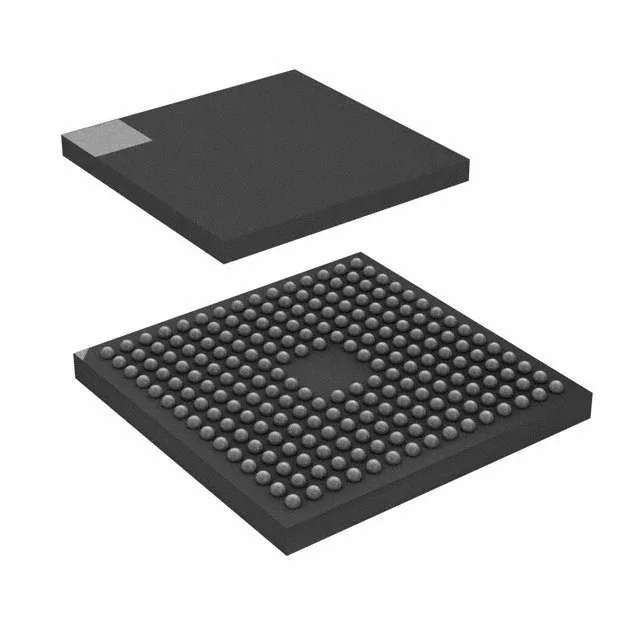
The STM32F439NIH6 is an STM32F4-series 32-bit MCU built around an ARM Cortex-M4 core clocked at 180 MHz, with 2 MB of Flash and 256 KB of RAM. This part sits at the high-density end of the STM32F4 lineup, packing enough memory and peripheral set to run a graphical user interface, manage an Ethernet-connected gateway, and handle real-time control loops from a single chip. The 168 I/O pins and the 216-TFBGA package (13x13 mm) mean this is a board-space-conscious design — the BGA saves area but demands a multi-layer PCB with via-in-pad capability for the fine-pitch balls. The 180 MHz core with single-cycle multiply-accumulate and hardware FPU handles DSP and filter workloads without a separate coprocessor. Flash wait states need attention in the clock tree: at 180 MHz you'll set at least 5 wait states per the reference manual, which the prefetch buffer and instruction cache mostly hide for sequential code.
Connectivity set — Ethernet, CAN, USB OTG, and a 24-channel ADC
This MCU carries Ethernet MAC, dual CAN interfaces, USB OTG, and a full complement of serial buses (SPI, I²C, UART/USART, I²S). The Ethernet MAC with dedicated DMA means you can run a lightweight TCP/IP stack without an external PHY — just add the magnetics and an RMII interface. The LCD controller peripheral drives parallel RGB interfaces directly, which saves an external display driver for TFT panels up to XGA resolution. Brown-out detect and POR are integrated, so external supervisor ICs are optional for most designs.
ROHS3 compliant. For production planning, this means no last-time-buy pressure and continued factory support through ST's distribution channel. The base product number STM32F439 covers the family; density and package variants share the same die and peripheral set, so firmware portability across the family is straightforward.
216-TFBGA — layout considerations
The 216-ball TFBGA (13x13 mm) with 0.8 mm pitch is a standard BGA that four-layer boards can route with careful fan-out. Decoupling: place a 100 nF cap per supply ball pair, plus a 4.7 µF bulk on each supply rail within 10 mm of the package.