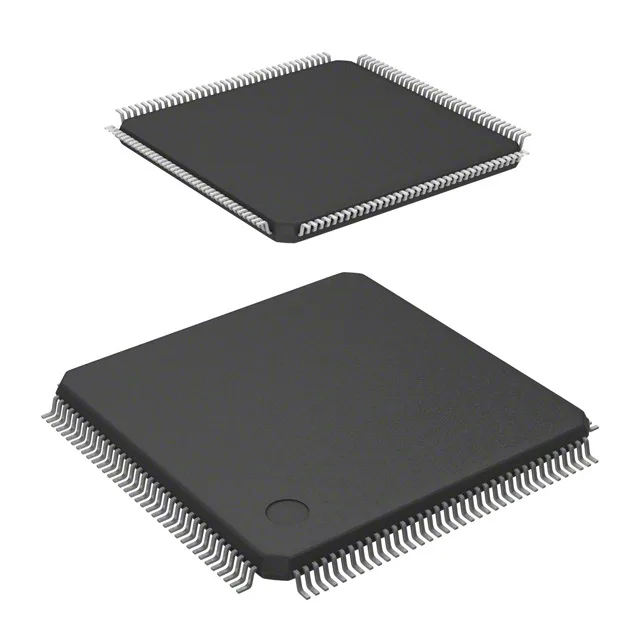
STMicroelectronics STM32F429ZIT7 — Microcontrollers & Processors (MCU / MPU / DSP)

STM32F429ZIT7 STM32F4 MCU, ARM Cortex-M4 180MHz, 2MB Flash

MPNSTM32F429ZIT7
End of Life

STMicroelectronics STM32F4 series, 32-bit ARM Cortex-M4 single-core MCU, 180MHz, 2MB Flash, 256KB RAM, 144-LQFP tray, 114 I/O, Ethernet, USB OTG, 24x12b ADC, -40 to 105°C operating temperature, 1.7 to 3.6V supply, Active lifecycle.

$16.1132Ref. price · indicative, final on quote
Independent supplier — new & surplus stockAuthenticity-screened · ESD-safe packingListing updated Jul 2026

Specifications

STM32F429ZIT7 specifications
ParameterValue
SeriesSTM32F4
MountingSurface Mount
Oscillator typeInternal
Program memory typeFLASH
Voltage - supply (Vcc (Vdd))1.7V ~ 3.6V
Operating temperature-40°C~105°C(TA)
Speed180MHz
PackageTray
RAM size256K x 8
Core size32-Bit Single-Core
PeripheralsBrown-out Detect/Reset, DMA, I²S, LCD, POR, PWM, WDT
ConnectivityCANbus, EBI/EMI, Ethernet, I²C, IrDA, LINbus, SPI, UART/USART, USB OTG
Number of i (O)114
Core processorARM® Cortex®-M4
Case144-LQFP
Data convertersA/D 24x12b; D/A 2x12b
Program memory size2MB (2M x 8)

Product details

What the 180 MHz Cortex-M4 buys you in this package

The STM32F429ZIT7: It is built for applications that need a DSP-capable core with a rich peripheral set — think graphical user interfaces driven through the LCD controller, Ethernet-connected industrial gateways, or multi-protocol fieldbus nodes. The 144-LQFP package (20x20 mm) gives you 114 I/O, enough to route a parallel LCD interface alongside CAN, Ethernet, and multiple UART/SPI/I²C buses without multiplexing pain.

The 2 MB (2M x 8) program Flash is the largest density in the STM32F429 line, which matters when you are fitting a TCP/IP stack, a graphics library, and a file system into a single chip. The 256 KB SRAM (organized as 256K x 8) is shared between core data and peripheral DMA buffers — the Ethernet controller and the LCD controller both chew through SRAM, so budget accordingly.

Connectivity and peripheral set for a system-on-chip design

The I²S interface pairs with the DAC for audio output, and the LCD controller drives a parallel RGB display directly. The internal oscillator can serve as the system clock, though an external crystal is recommended for Ethernet timing accuracy.

Frequently asked questions

What are the differences between STM32F429ZIT7 and STM32F429ZIT6?

The primary difference is the operating temperature range. All other specifications — 180 MHz Cortex-M4 core, 2 MB Flash, 256 KB RAM, 144-LQFP package, 114 I/O, and peripheral set — are identical between the two. The '7' variant is the industrial-temperature choice for environments that exceed 85°C.

What is the flash memory size of STM32F429ZIT7?

The STM32F429ZIT7 has 2 MB of program Flash memory, organized as 2M x 8 bits. This is the largest Flash density in the STM32F429 line, suitable for complex firmware with graphics, networking, and file system stacks.

What is the maximum operating temperature of STM32F429ZIT7?

This industrial temperature grade qualifies the part for motor drives, outdoor telecom, and factory automation without derating.