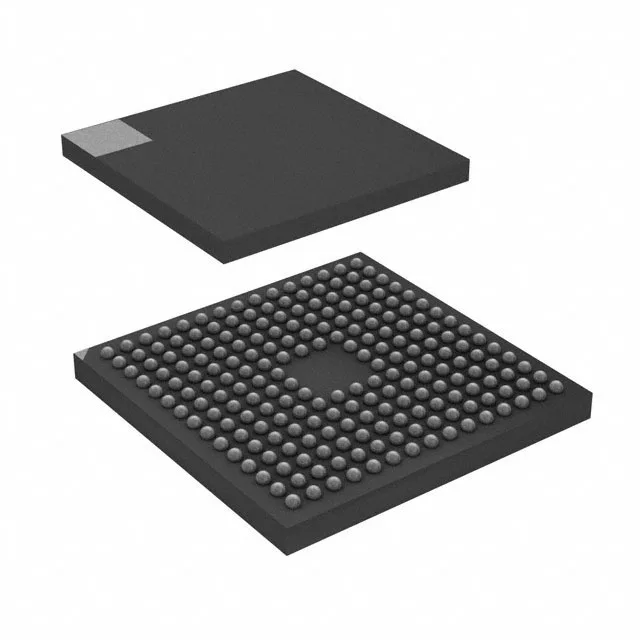
With 168 I/O lines and a 216-ball TFBGA package (13x13 mm), this part targets high-end embedded applications such as industrial HMIs, networked motor drives, and display-centric control panels that need both processing throughput and connectivity.
180 MHz Cortex-M4 — what the speed rating means
The 180 MHz core clock with single-cycle multiply and hardware FPU gives this part enough headroom for real-time control loops, audio processing, or lightweight graphics rendering without external DSP. At this speed, Flash wait states need careful configuration — expect to budget at least one wait state above 150 MHz to avoid bus faults on tight branches.
2 MB Flash and 256 KB SRAM — memory budget for firmware
The 2 MB on-chip Flash is sized for large application code, GUI frame buffers, or OTA staging without external memory. The 256K x 8 SRAM (256 KB) supports moderate data buffers and stack depth; designs needing more than that will use the EBI/EMI to add SDRAM or SRAM externally.
Peripheral set: Ethernet, LCD, CAN, USB OTG
Built-in Ethernet MAC, a TFT LCD controller, CAN 2.0B, and USB OTG FS/HS make this MCU a single-chip solution for industrial gateways, smart displays, and in-vehicle telematics. The LCD controller supports up to XGA resolution with an external display buffer, while the Ethernet MAC works with an external PHY for 10/100 Mbps networking.
ST lists the STM32F429NIH6J as obsolete. Buyers should verify date codes and inspect for counterfeit risk when procuring from the spot market.