The 168 I/O lines and rich peripheral set — Ethernet, CANbus, USB OTG, plus an LCD controller — make it a single-chip candidate for industrial HMI panels, motor drives with fieldbus, and networked control nodes where the processor handles both the application and the display.
512 KB Flash and 256K x 8 SRAM — sizing the firmware and data budget
The 512 KB Flash (512K x 8) sets the upper bound for the compiled image, bootloader, and any OTA staging partition. If your application already runs a GUI library and TCP/IP stack, measure the.text size against this ceiling early — the STM32F429BGT6 sibling doubles the Flash to 1 MB, but the BET6 keeps BOM cost lower when the firmware fits. The 256K x 8 SRAM supports moderate frame buffers (e.g., a 320x240 16-bit display needs 150 KB) plus stack and heap for multiple protocol stacks. For data-heavy logging or large lookup tables, the EBI/EMI interface lets you add external SRAM or SDRAM without a glue-logic FPGA.
Connectivity and peripherals — Ethernet, CAN, USB OTG, and LCD on one die
For a motor-drive control board, that means one chip handles the field-oriented control loop (Cortex-M4 DSP instructions), encoder feedback via SPI or timer capture, CANopen communication to the PLC, and a local HMI over the LCD controller — no separate display controller or fieldbus ASIC. The brown-out detect and POR on the reset generator keep the system from running on a drooping rail.
Industrial temperature range and 208-LQFP package
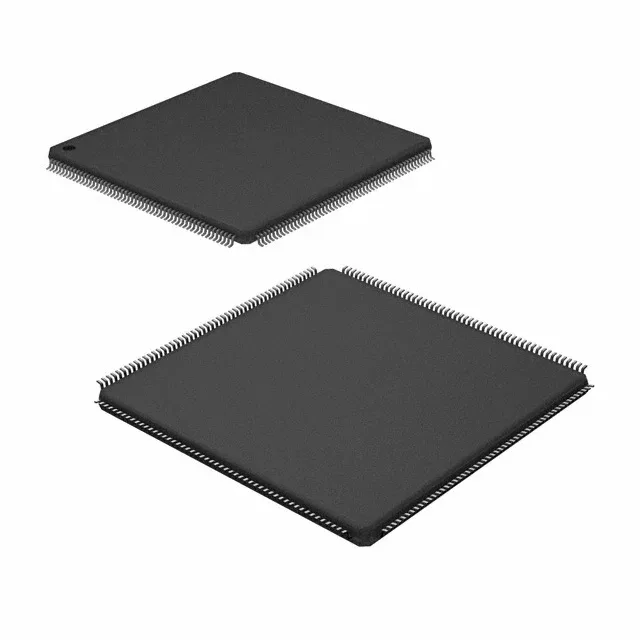
The 208-LQFP (28x28 mm body) is a hand-solderable, inspectable package with 0.5 mm pitch — rework techs can replace it with hot air and a stencil, unlike a BGA.
ST lists the STM32F429BET6 as Active. The STM32F4 series remains a mainstream portfolio for ST, so PCNs are typically package or wafer-fab related rather than discontinuation. For production programs that need a multi-year supply window, this part carries no imminent obsolescence risk.