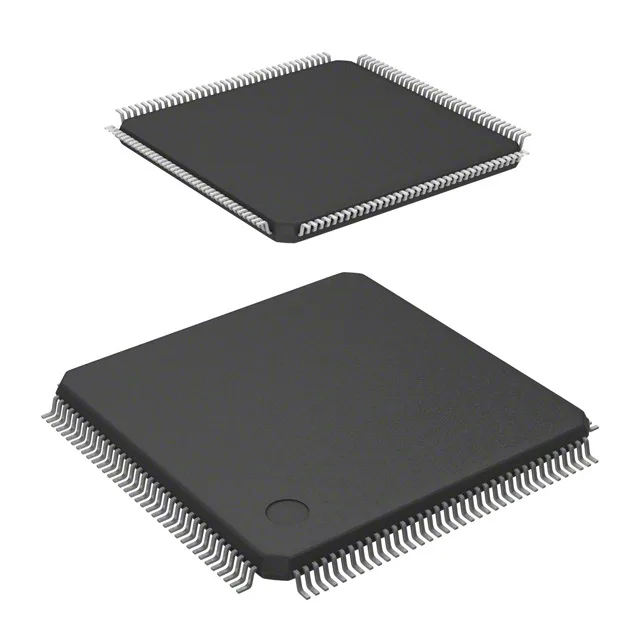
100 MHz Cortex-M4 with 1.5 MB Flash — memory headroom for complex firmware
The 114 I/O lines in a 144-LQFP package give board designers flexibility to route parallel LCD buses, external memory interfaces, and multiple serial peripherals without signal contention.
Peripheral set and connectivity — what the bus architecture supports
This MCU integrates CANbus, USB OTG, QSPI, SAI, and multiple UART/USART, I²C, and SPI interfaces. The QSPI interface lets you attach external serial Flash or PSRAM for data logging or font storage without tying up the main data bus. The SAI peripheral is a serial audio interface that can connect to external codecs or digital microphones, making this part suitable for voice-command front ends or audio playback systems. The DAC channels can generate analog waveforms or bias voltages for sensor excitation, while the ADC's 16 channels cover multi-axis analog sensing without external muxing. The DMA peripheral offloads ADC result transfers and serial data movement, keeping the Cortex-M4 free for control-loop math. The LCD peripheral supports direct connection to small-format graphical or segment LCD panels, which saves a separate display driver IC in human-machine interface designs. The PWM timers can drive motor phases or LED dimming channels with dead-time insertion for half-bridge control.
144-LQFP package — layout and thermal considerations
The exposed pad (if present on the bottom) should be stitched to a solid ground plane with thermal vias to keep junction temperature within limits when the MCU is running at 100 MHz with most I/O toggling.
The base product number STM32F423 indicates it belongs to the high-feature-density tier of the STM32F4 family, which shares pin compatibility across density options within the 144-pin LQFP footprint. For dual-sourcing resilience, the STM32F423 is an ST-proprietary architecture without an official second-source alternate from another manufacturer.