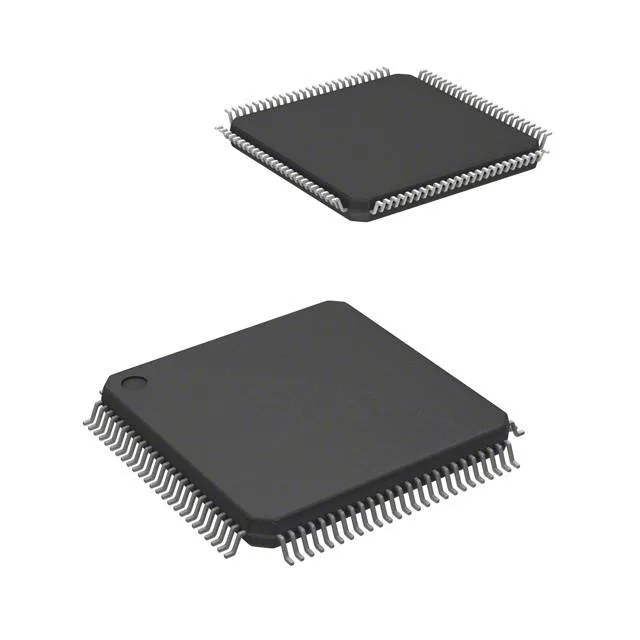
STMicroelectronics STM32F417VET6 — Microcontrollers & Processors (MCU / MPU / DSP)

STM32F417VET6 STM32F4 MCU 32-bit ARM Cortex-M4 168MHz 512KB

MPNSTM32F417VET6
Active

STMicroelectronics STM32F4 series, STM32F417VET6, ARM Cortex-M4, 32-Bit Single-Core, 168MHz, 512KB Flash, 192K x 8 RAM, Ethernet, CANbus, USB OTG, 100-LQFP, -40°C to 85°C.

$13.0500Ref. price · indicative, final on quote
Packaging100-LQFP
RoHSROHS3 Compliant
SeriesSTM32F4
Independent supplier — new & surplus stockAuthenticity-screened · ESD-safe packingListing updated Aug 2026

Specifications

STM32F417VET6 specifications
ParameterValue
SeriesSTM32F4
MountingSurface Mount
Oscillator typeInternal
Program memory typeFLASH
Voltage - supply (Vcc (Vdd))1.8V ~ 3.6V
Operating temperature-40°C ~ 85°C (TA)
Speed168MHz
PackageTray
RAM size192K x 8
Core size32-Bit Single-Core
PeripheralsBrown-out Detect/Reset, DMA, I²S, LCD, POR, PWM, WDT
ConnectivityCANbus, DCMI, EBI/EMI, Ethernet, I²C, IrDA, LINbus, SPI, UART/USART, USB OTG
Number of i (O)82
Core processorARM® Cortex®-M4
Case100-LQFP
Data convertersA/D 16x12b; D/A 2x12b
Program memory size512KB (512K x 8)

Product details

Ethernet, CAN, and USB OTG — what the peripheral set buys the design

The STM32F417VET6: The dual CAN 2.0B controllers handle the CANopen physical layer without an external SPI-to-CAN bridge. USB OTG with on-chip PHY supports both host and device roles.

512 KB Flash and 192 KB SRAM — sizing the firmware and data buffers

The 512 KB Flash is large enough for a FreeRTOS-based application with a TCP/IP stack, a CANopen stack, and a USB device class driver, leaving room for an OTA staging area if the application uses the internal Flash for bootloader and application partitions. The 192 KB SRAM is split across a 128 KB main block and a 64 KB CCM (core-coupled memory) block that runs at full 168 MHz with zero wait states — the CCM block is ideal for time-critical interrupt service routines and audio or FFT buffers. The 12-bit ADC array (16 channels) and dual 12-bit DAC round out the analog front-end for sensor conditioning and closed-loop control outputs.

The ROHS3 compliance covers the current EU regulatory requirements without an exemption expiry concern.

100-LQFP (14x14 mm) — layout and soldering considerations

The 82 I/O count leaves enough headroom for a parallel LCD interface, an external SRAM/Flash via FSMC, and a few spare GPIOs for panel buttons and status LEDs.

Frequently asked questions

What is the difference between STM32F417VET6 and STM32F407VET6?

The STM32F417VET6 adds an Ethernet MAC and a camera interface (DCMI) that the STM32F407VET6 lacks. Both share the same 168 MHz Cortex-M4 core, 512 KB Flash, 192 KB SRAM, and 100-LQFP footprint, so the F417 is a pin-compatible superset for designs that need wired networking or video capture.