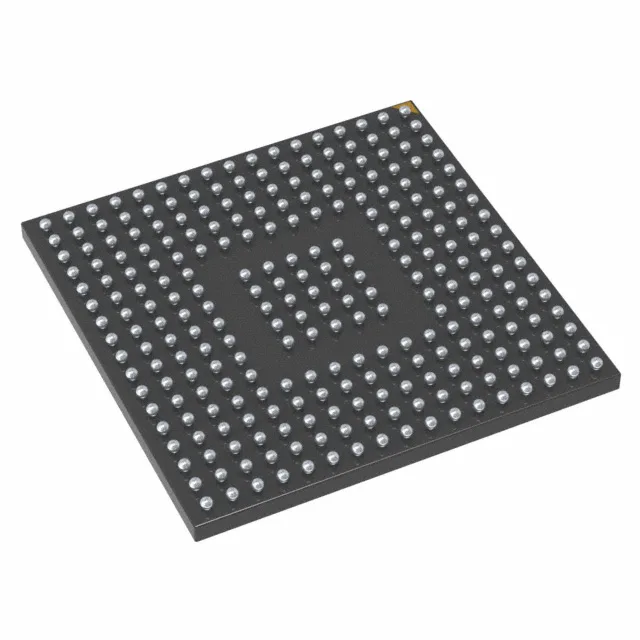
What this STM32F417IGH6W brings to the BOM
The STM32F417IGH6W is an STMicroelectronics STM32F4 series 32-bit ARM Cortex-M4 single-core MCU clocked at 168 MHz, with 1 MB of Flash and 192 KB of SRAM. It targets applications that need a mix of compute throughput and rich connectivity: the peripheral set includes Ethernet MAC, USB OTG (full-speed and high-speed), two CAN 2.0B interfaces, multiple SPI/I2C/UART, a DCMI camera interface, and an external memory controller (EBI/EMI). The 140 I/O pins in a 201-ball UFBGA (10x10 mm) package give board designers flexibility for parallel buses and sensor arrays.
Memory budget and the 192 KB SRAM wall
With 1 MB Flash you can host a full RTOS, TCP/IP stack, and application code without external storage for most industrial gateways. The 192 KB SRAM is the tighter constraint: if your design runs multiple large frame buffers (Ethernet jumbo frames, camera capture, or a GUI framebuffer), budget the allocation early. The 168 MHz Cortex-M4 with single-cycle multiply and FPU handles DSP loops and motor-control FOC in software, but the SRAM ceiling may push you to use the external memory interface (EBI/EMI) for additional SRAM or SDRAM.
Connectivity: one chip for the gateway role
The Ethernet MAC with dedicated DMA and the USB OTG high-speed PHY (external PHY required for HS) let this MCU serve as a protocol converter or edge gateway without an external host processor. The two CAN interfaces suit automotive or industrial bus bridging. The DCMI parallel camera interface can stream VGA frames into SRAM for vision-based trigger logic. For designs that need both Ethernet and USB host, the STM32F417IGH6W eliminates a second MCU or a separate USB-to-Ethernet bridge chip.
Package and assembly: the UFBGA trade-off
The 176+25 UFBGA (10x10 mm) with 0.5 mm ball pitch demands a controlled impedance PCB with microvias or blind vias for signal breakout. The fine pitch means the board house needs LDI (laser direct imaging) and a solder-paste stencil matched to the 0.3 mm pad diameter.
For dual-sourcing resilience, the pin-compatible STM32F407IGH6W (same package, same pinout, same Flash/SRAM) is a validated drop-in if the application can tolerate the absence of the cryptographic accelerator and Ethernet — verify the peripheral differences against your firmware before committing the alternate.