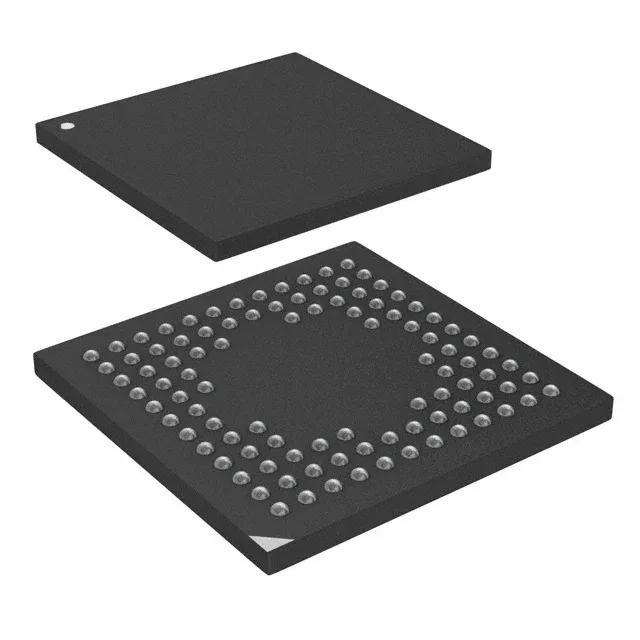
The Cortex-M4 includes a single-precision floating-point unit, so FIR filters, FFTs, and PID loops run in hardware rather than soft-emulated — a meaningful difference from an M3 or M0+ part if your firmware does any real-time math. The 512 KB on-chip Flash and 128 KB SRAM give you room for a moderate application stack: RTOS, USB stack, and a couple of control loops fit without needing external memory.
Peripheral set and I/O budget
With 81 I/O lines brought out on the 100-UFBGA package, this part can handle a sensor array, a parallel LCD bus, and still leave pins for UART and SPI debug headers.
That saves board area versus a 100-pin LQFP, but it means the PCB fab needs via-in-pad or microvias for routing, and the reflow profile must be BGA-capable.
That means normal production, no last-time-buy clock ticking, and standard lead times through the distribution channel. The base product number is STM32F411, so firmware and board layout are shared across the VE density options — a useful hedge if you need to scale Flash or RAM in a future spin without a PCB change. ROHS3 compliant.