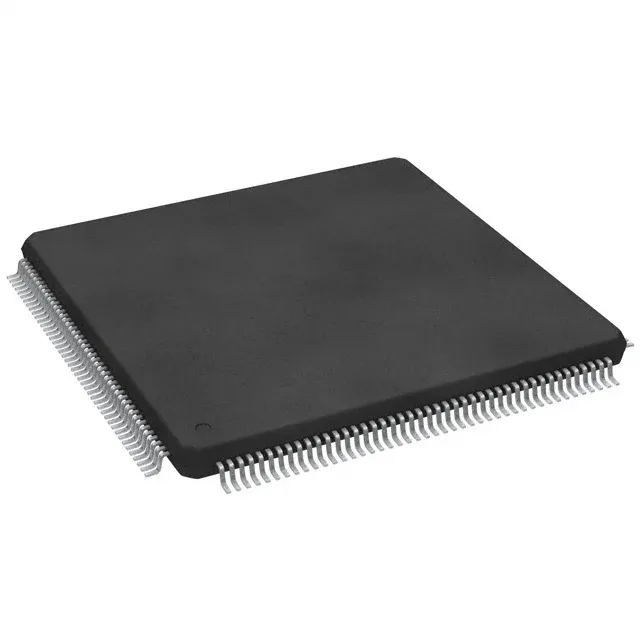
168 MHz Cortex-M4 with peripheral density for industrial control
The STM32F407IET6 is an STMicroelectronics STM32F4 series MCU built around an ARM Cortex-M4 core with FPU, clocked at 168 MHz. What sets this device apart in the STM32F4 line is the connectivity suite: it integrates a 10/100 Ethernet MAC with dedicated DMA, USB OTG (host and device) with on-chip PHY, two CAN 2.0B interfaces, and a camera interface (DCMI). The peripheral set includes multiple 12-bit ADCs (24 channels), dual 12-bit DACs, a flexible static memory controller (FSMC) for external SRAM/NOR/NAND, and an LCD parallel interface.
Memory and bus — sizing the firmware staging area
The 192 KB SRAM is split across a 128 KB block on the main AHB bus and a 64 KB block on the peripheral bus (plus 4 KB backup SRAM). For designs running a real-time OS with Ethernet and USB stacks, the 192 KB leaves enough headroom for moderate-sized frame buffers and protocol stacks without external memory. The FSMC interface on the EBI/EMI pins can drive external NOR/NAND or SRAM if the application needs more working memory.
Ethernet and USB OTG — what the connectivity means on the board
The Ethernet MAC supports 10/100 Mbit/s with MII and RMII interfaces. It includes a dedicated DMA controller that offloads frame handling from the Cortex-M4 core. The USB OTG peripheral operates in host, device, or OTG mode and includes a full-speed PHY on-chip (no external transceiver needed for full-speed). For high-speed USB, an external PHY connects via the ULPI interface. Both peripherals share the AHB bus matrix, so a design running Ethernet and USB simultaneously needs to budget bus bandwidth — the DMA engines handle most of the traffic, but interrupt latency from the two stacks can stack up under heavy load.
The STM32F4 series has been a long-running line from ST, with a broad ecosystem of tools, middleware, and reference designs. For supply planning, the part is available through franchised distribution and the independent channel, with no last-time-buy clock running.
Package and footprint — 176-LQFP rework considerations
Rework with hot air at 350°C to 380°C, preheating the board to 125°C to reduce thermal shock.