The Cortex-M4 core includes a single-cycle multiply-accumulate (MAC) and saturating arithmetic, so the DSP extension handles real-time filtering and FFT work without a separate coprocessor — useful for motor-control current loops and audio processing where the 84 MHz clock keeps the interrupt latency under 20 cycles. Program memory is 512 KB of Flash and the SRAM is 96 KB organized as 96K x 8. That Flash footprint is sized for a moderate application stack — an RTOS plus a USB stack and a few protocol layers — while the 96 KB SRAM leaves room for double-buffered ADC data or a small display frame buffer without external memory.
Connectivity and peripherals — USB OTG, I²S, and 81 I/Os
The part includes USB OTG full-speed, three SPI, three I²C, four USART/UART, SDIO, and an I²S audio interface. The 81 general-purpose I/Os in the 100-UFBGA package give enough pins to drive a parallel LCD data bus, a keypad matrix, and several external sensors simultaneously. The 16-channel 12-bit ADC samples at up to 2.4 MSps — fast enough for three-phase current sensing with a 10 kHz current loop, though the internal reference accuracy sets the usable resolution at about 10.5 effective bits in practice.
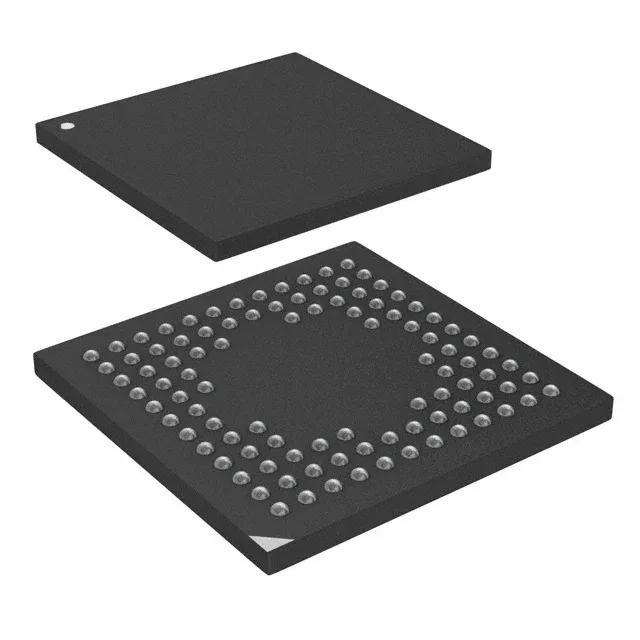
The 100-UFBGA (7x7 mm) package with 0.5 mm ball pitch demands a four-layer PCB minimum for fanout — the inner layers carry the VDD and VSS planes that the BGA balls connect to through microvias.