What the 84 MHz Cortex-M4 buys you on the BOM
That core speed, combined with 384 KB of Flash and 96 KB of SRAM, puts it in the performance tier for motor-control loops, audio processing, or real-time control tasks where a Cortex-M3 at 32 MHz would run out of headroom.
384 KB Flash, 96 KB SRAM — sizing the firmware and heap
Program memory is 384 KB of Flash, organized as 384K x 8. The 96 KB SRAM is enough for a FreeRTOS heap with several moderate-sized buffers, a USB stack, and a TCP/IP offload. For most sensor-fusion, fieldbus-gateway, or UI-controller tasks, this memory balance works without external RAM.
81 I/O in a 100-LQFP — routing and footprint
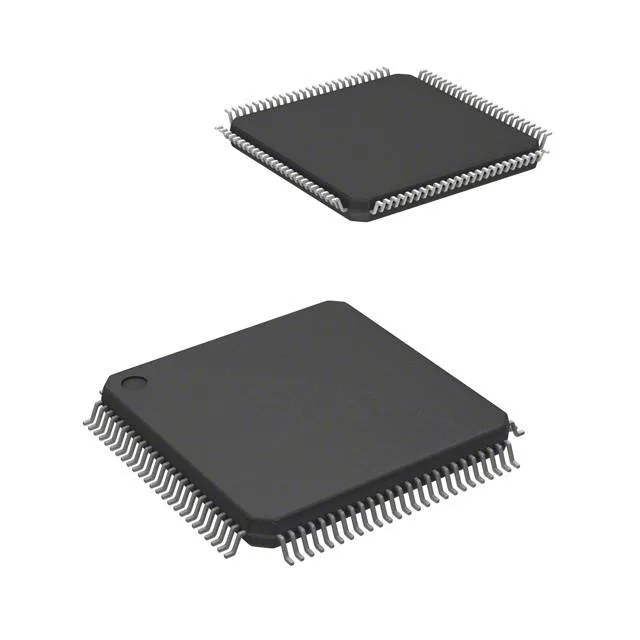
The 100-LQFP package (14x14 mm body) brings out 81 general-purpose I/O. That is enough for a parallel LCD interface, an external memory bus, and several serial peripherals simultaneously. The fine-pitch (0.5 mm) QFP is hand-solderable with a decent iron and a flux pen, but for production runs a reflow profile per J-STD-020 is the standard.
Connectivity and peripherals for a system-on-chip approach
The peripheral set includes USB OTG (host/device), SDIO for SD cards, three SPI, three I²C, and up to six UART/USART with IrDA and LIN support. The internal oscillator is accurate enough for UART baud-rate generation but not for USB — an external crystal is recommended for USB operation.
Industrial temperature range and lifecycle
ROHS3 compliant. No AEC-Q100 qualification — not for automotive under-hood or chassis domains.
Sourcing posture for the STM32F401VDT6
This part is in the active allocation window for the STM32F4 family. Lead times have stabilized from the 2021-2023 shortage peaks, but the 100-LQFP variant can still see extended cycles during high-demand quarters. We source through franchised distribution and verified independent channels, with traceability back to the manufacturer date code.