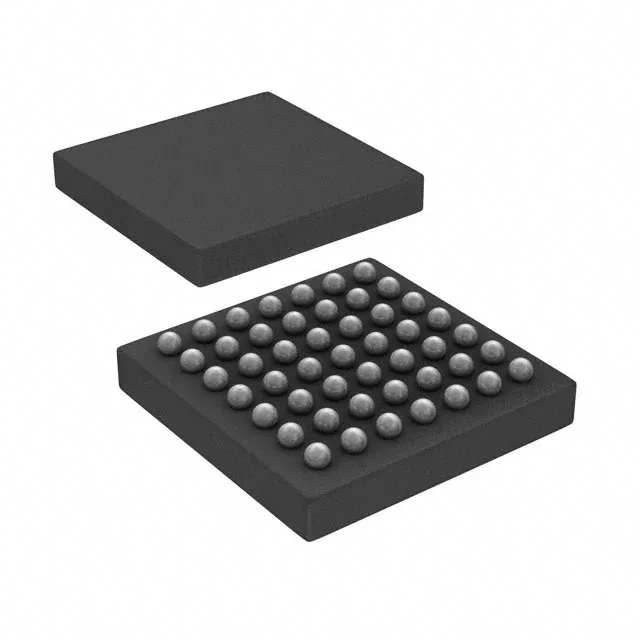
The STM32F401CCY6BTT is an STMicroelectronics ARM Cortex-M4 microcontroller from the STM32F4 series, packing a 32-bit single-core processor running at 84 MHz with a 256 KB Flash program memory and 64 KB of SRAM. The core includes single-cycle DSP instructions and a floating-point unit, so it can handle real-time control loops and audio filtering without an external DSP.
At 84 MHz the Cortex-M4 delivers about 105 DMIPS from its single-cycle MAC and hardware divide. That is enough headroom to run a field-oriented motor-control loop with sensorless observer at 20 kHz PWM update rate, or to decode an MP3 stream in software while the USB OTG interface handles audio streaming.
256 KB Flash / 64 KB SRAM — sizing the firmware and data buffers
The 256 KB Flash can hold a moderate FreeRTOS application with a USB stack and a TCP/IP library, leaving room for a bootloader and OTA update staging area. The 64 KB SRAM is shared between code data, stack, and DMA buffers — enough for a 320x240 framebuffer (153 KB) would not fit, but a 128x64 OLED display buffer (1 KB) leaves most of the RAM for sensor data logging. If your application needs more than 64 KB of contiguous RAM, step up to the STM32F401RE (128 KB SRAM) in a larger package.
WLCSP package — board-level considerations
The 49-ball WLCSP (2.97 mm square, 0.4 mm pitch) is the smallest package option for this MCU, but it demands a controlled assembly process. The balls are directly on the die, so the package has no overmold — handling with vacuum pick-and-place is standard, but the die is exposed and can crack if the nozzle pressure is too high. The PCB land pattern should follow ST's application note AN4488 for the recommended solder-mask-defined pad geometry.
Peripherals and I/O — what is available on 36 pins
With 36 I/O pins the part exposes up to 3 SPI, 3 I²C, 3 USART (with IrDA and LIN), one SDIO, and one USB OTG interface. The 10-channel 12-bit ADC samples at up to 2.4 MSPS — enough for three-phase current sensing plus a temperature input in a motor drive. The DMA controller can service all peripherals without CPU intervention, which is critical for keeping the 84 MHz core free for control math while the ADC and SPI transfer data.
For dual-source flexibility, the base product number STM32F401 covers several Flash/RAM/package variants; the WLCSP package is specific to the CCY6 suffix, so a pin-compatible alternative within the same package family would be the STM32F401CCY6BTR (same die, different tape-and-reel orientation).