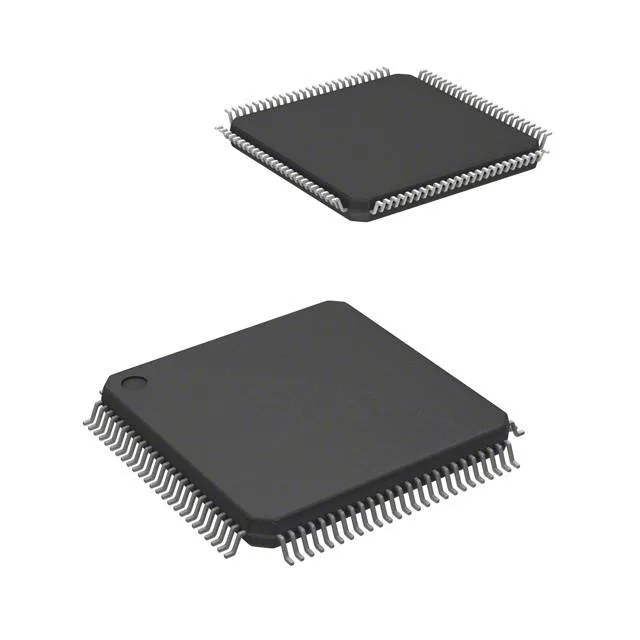
72 MHz Cortex-M4F with FPU — signal-chain MCU for mixed-signal control
The distinguishing feature of this part is its dense analog peripheral set: 16 multiplexed 12-bit ADC channels, 21 dedicated 16-bit sigma-delta ADC channels, and three 12-bit DAC outputs — a configuration that targets sensor fusion, motor-control feedback loops, and instrumentation front-ends where you need both fast SAR conversions and high-resolution sigma-delta measurements on the same die.
Program memory is 256 KB of Flash, organised as 256K x 8. The 32 KB SRAM (32K x 8) is the working memory budget. For a typical sensor-fusion application running a real-time OS, a communications stack, and a floating-point control loop, 256 KB Flash is comfortable for mid-complexity firmware; the 32 KB SRAM means the data buffers and stack need careful sizing — consider external SRAM or a denser sibling if your application holds large lookup tables or high-rate data logs. The Flash is rated for 100k erase/write cycles per sector, adequate for field-update OTA staging with wear-leveling in the bootloader.
Analog subsystem — 16x12b SAR + 21x16b ΣΔ ADC, 3x12b DAC
The STM32F378VCT6 carries a dual ADC architecture: a 12-bit successive-approximation ADC with 16 multiplexed channels for moderate-speed voltage or current sensing, and a separate 16-bit sigma-delta ADC with 21 channels for precision low-bandwidth measurements such as thermocouple, strain-gauge, or current-shunt outputs. Three 12-bit DAC channels provide analog output for set-point generation or waveform synthesis.
Supply range 1.65 V to 1.95 V — single low-voltage rail
The core and I/O share a single supply rail from 1.65 V to 1.95 V. This narrow range is unusual — most STM32F3 parts run at 2.0 V to 3.6 V. The 1.8 V nominal supply suits battery-powered or energy-harvesting designs where the system rail is already 1.8 V, but it means you cannot drop this part into a 3.3 V legacy board without a regulator. The internal oscillator and POR are operational across the full range, so no external supervisor is needed for brown-out protection.
No successor has been designated because none is needed — the part remains a current catalog offering.