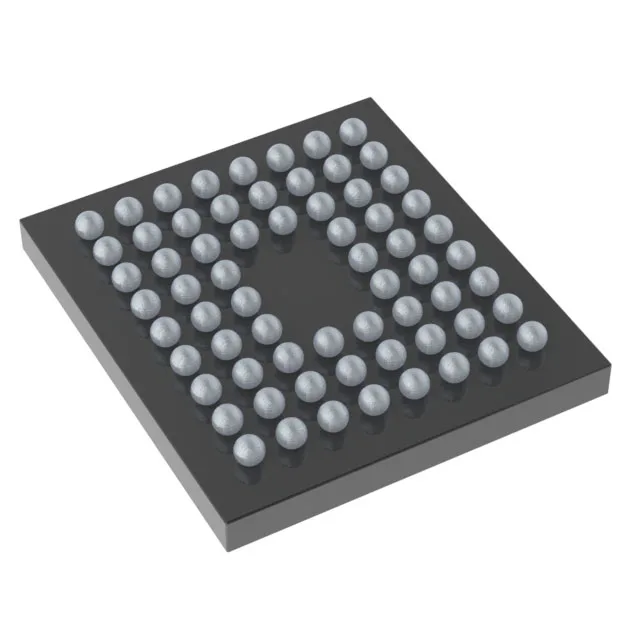
Mixed-signal MCU with a floating-point unit and dense analog peripheral set
The STMicroelectronics STM32F378RCY6TR is a 32-bit microcontroller built around an ARM Cortex-M4F core with single-precision floating-point unit, clocked at 72 MHz. It sits in the STM32F3 series, which targets applications needing a blend of control processing and analog signal chain integration — think motor drives, digital power conversion, industrial sensors, and instrumentation where you want to keep the ADC/DAC on the same die as the control loop. The flash memory is 256 KB, paired with 32 K x 8 of SRAM, which is enough for a real-time operating system and a modest application stack without external memory. The part includes a 16-channel 12-bit ADC, a 21-channel 16-bit ADC, and three 12-bit DACs — an unusually rich analog front-end for a mid-density MCU, letting a single chip handle multiple sensor inputs and generate analog control outputs.
66-WLCSP — what the package means for the board and the rework station
This variant comes in a 66-ball WLCSP (wafer-level chip-scale package) measuring 3.8 x 4.2 mm. It is a direct-attach package with no mould compound — the die backside is the top surface, and the solder balls are the only stand-off. The ball pitch is fine enough that a standard hot-air rework station can handle it if the board has a soldermask-defined pad pattern, but you will want a pre-heater underneath to avoid cold joints on the inner balls. The WLCSP is not the easiest package to hand-solder or probe — there are no exposed leads. For prototyping or low-volume production, the LQFP-64 or UFQFPN-48 variants of the STM32F378 are more rework-friendly. But if board space is the constraint, this package saves roughly 40% of the footprint versus a TQFP-64.
STMicroelectronics lists the STM32F378RCY6TR as Active on the product status. The base product number is STM32F378, and the 'RC' designation indicates 256 KB flash with 32 K x 8 RAM; the 'Y6' suffix is the WLCSP package.