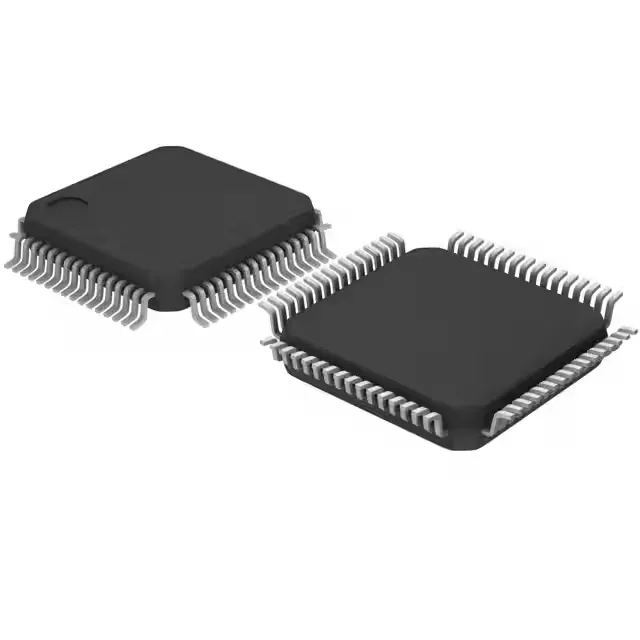
STMicroelectronics STM32F378RCT6 — Microcontrollers & Processors (MCU / MPU / DSP)

STM32F378RCT6 ARM Cortex-M4F MCU, 72 MHz, 256 KB Flash

MPNSTM32F378RCT6
Active

STMicroelectronics STM32F3 series, ARM Cortex-M4F 32-bit MCU, 72 MHz, 256 KB Flash, 32K x 8 RAM, 64-LQFP (10x10), 1.65 V ~ 1.95 V supply, -40°C ~ 85°C.

$5.3160Ref. price · indicative, final on quote
Independent supplier — new & surplus stockAuthenticity-screened · ESD-safe packingListing updated Jul 2026

Specifications

STM32F378RCT6 specifications
ParameterValue
SeriesSTM32F3
MountingSurface Mount
Oscillator typeInternal
Program memory typeFLASH
Voltage - supply (Vcc (Vdd))1.65V ~ 1.95V
Operating temperature-40°C~85°C(TA)
Speed72MHz
PackageTray
RAM size32K x 8
Core size32-Bit Single-Core
PeripheralsDMA, POR, PWM, WDT
ConnectivityCANbus, HDMI-CEC, I²C, IrDA, LINbus, SPI, UART/USART
Number of i (O)51
Core processorARM® Cortex®-M4F
Case64-LQFP
Data convertersA/D 16x12b, 21x16b; D/A 3x12b
Program memory size256KB (256K x 8)

Product details

Cortex-M4F with FPU in a 1.8 V core — the mixed-signal workhorse

That ADC count — 37 total channels — makes this part a signal-chain MCU for applications that need to digitise multiple sensor inputs without external multiplexers or separate ADCs.

64-LQFP — rework-friendly, but watch the 1.8 V plane

The 64-LQFP (10x10 mm) is a standard fine-pitch package that reflows cleanly with a typical leaded profile. The exposed paddle is not present on this package — all dissipation goes through the leads, so thermal budget is limited. The 1.65 V to 1.95 V supply on the VDD pins means the decoupling caps should be 100 nF per pin pair plus a bulk 4.7 µF or 10 µF on the 1.8 V plane; do not share this rail with a 3.3 V peripheral supply without a level translator.

51 I/O and CANbus — industrial and automotive-adjacent connectivity

The HDMI-CEC interface is a niche addition useful for consumer AV equipment.

ST lists the STM32F378RCT6 as Active. The base product number STM32F378 sits in the STM32F3 series, which remains a current portfolio line. The 64-LQFP package is a common footprint across several STM32F3 density variants, so a pin-compatible drop-in to a higher Flash or RAM sibling is possible without a board spin if the firmware scales.

Frequently asked questions

What is the difference between STM32F378RCT6 and STM32F373RCT6?

The STM32F378RCT6 uses the Cortex-M4F core with FPU and runs at 72 MHz, while the STM32F373RCT6 uses the Cortex-M4 core without FPU and also runs at 72 MHz. The STM32F378 adds the floating-point unit for DSP and math-heavy tasks, and its ADC channel mix differs — 16x12-bit plus 21x16-bit versus the STM32F373's 1x12-bit plus 3x16-bit plus 1x16-bit sigma-delta. The supply voltage range is also tighter on the STM32F378 (1.65 V to 1.95 V) versus the STM32F373 (2.0 V to 3.6 V).

How to program STM32F378RCT6?

Programming uses the standard ARM Serial Wire Debug (SWD) interface via the SWDIO and SWCLK pins. ST's ST-Link/V2 or a third-party debug probe (J-Link, DAPLink) connects to the 4-pin SWD header. The internal bootloader also supports USART1, USART2, and CAN for serial programming. STM32CubeProgrammer or the IDE (STM32CubeIDE, Keil, IAR) handles flash loading and debug.