This supply voltage targets low-power or battery-operated designs where the core logic runs from a sub-2 V rail, while the I/O bank may still interface with external 3.3 V peripherals through level translation. The 72 MHz clock is the standard speed grade for this density tier in the STM32F3 family, balancing throughput for sensor fusion, motor control loops, and audio processing against Flash wait-state overhead — at 72 MHz the prefetch buffer and one wait state keep the pipeline fed without stalling on linear code.
The 1.65 V to 1.95 V supply is the core operating range for the Cortex-M4F logic — a regulator delivering 1.8 V ±5% is the typical choice, and the low dropout headroom means a 2.5 V input rail works with a small LDO. Designers should note that the I/O pins are not 5 V tolerant at this core voltage; the datasheet's absolute maximum ratings and GPIO characteristics define the actual input levels, which are typically 3.3 V compatible with the correct VDDIO configuration.
Peripherals and connectivity — what is on the die
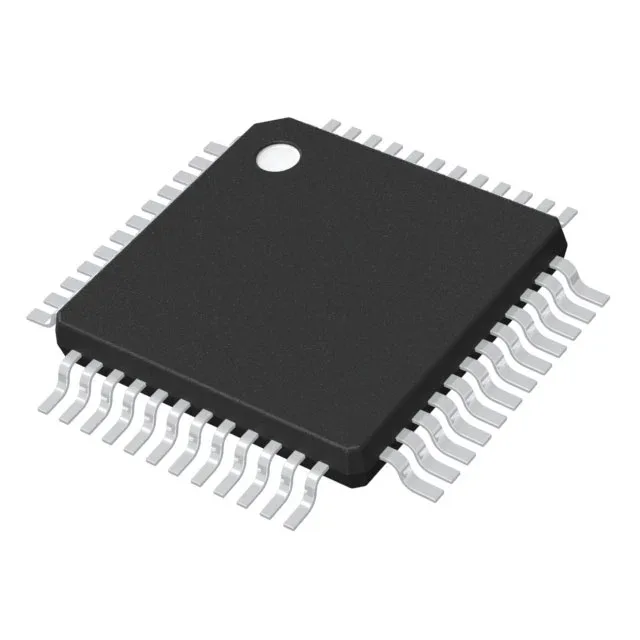
There are 36 general-purpose I/Os in the 48-LQFP package, along with a 4-channel 12-bit ADC and a 2-channel 12-bit DAC. Notably, no USB interface is listed in the connectivity set — designs requiring USB host or device will need an external USB-to-serial bridge or a different STM32 variant.