What the 72 MHz Cortex-M4 and 32 KB Flash mean for your control loop
Peripheral mix: analog density and connectivity
The 21x12b ADC covers a lot of analog inputs — typical for a three-phase motor drive reading shunt resistors plus a PFC stage. The three 12-bit DACs can generate reference voltages or analog control signals for external power-stage setpoints. DMA and PWM timers are built in, so the CPU can run the control algorithm while the peripherals handle the data movement and waveform generation.
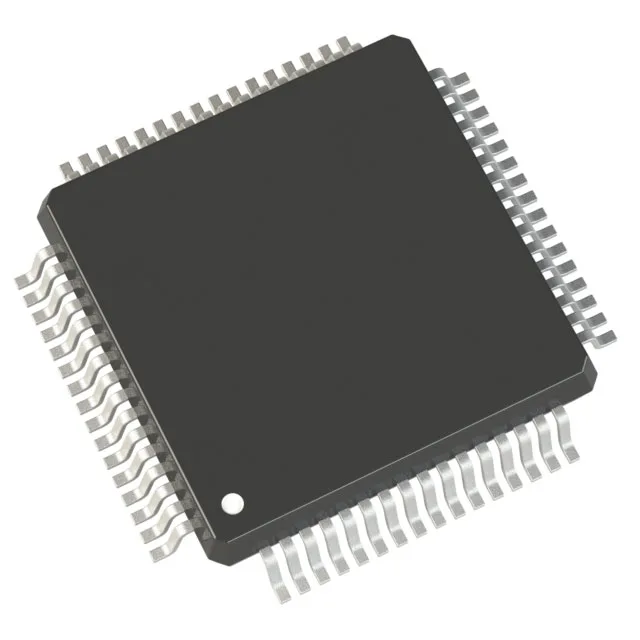
Package and temperature: 64-LQFP, industrial range
This covers factory-floor electronics, outdoor telecom cabinets, and HVAC controllers, but not under-hood automotive (that would need the -40 to 125°C or AEC-Q100 variants).
Supply voltage and power management
The POR and watchdog peripherals are on-chip, reducing the need for external supervisor ICs.
STMicroelectronics lists the STM32F334R6T6 with an active lifecycle status. The STM32F334 series is a current mainstream offering, so supply through the independent distribution channel is consistent.
Compatibility across the STM32F334 density options
The STM32F334R6T6 sits in the 32 KB Flash / 12 KB RAM tier. The same 64-LQFP footprint is shared with the STM32F334R4T6 (16 KB Flash) and STM32F334R8T6 (64 KB Flash). If your firmware outgrows 32 KB, the R8 variant is a pin-compatible drop-in with double the code space and the same 72 MHz core and peripheral set. If cost is tight and your code fits in 16 KB, the R4 saves a few cents per unit. The RAM stays at 12 KB across all three, so the data buffer budget doesn't change.