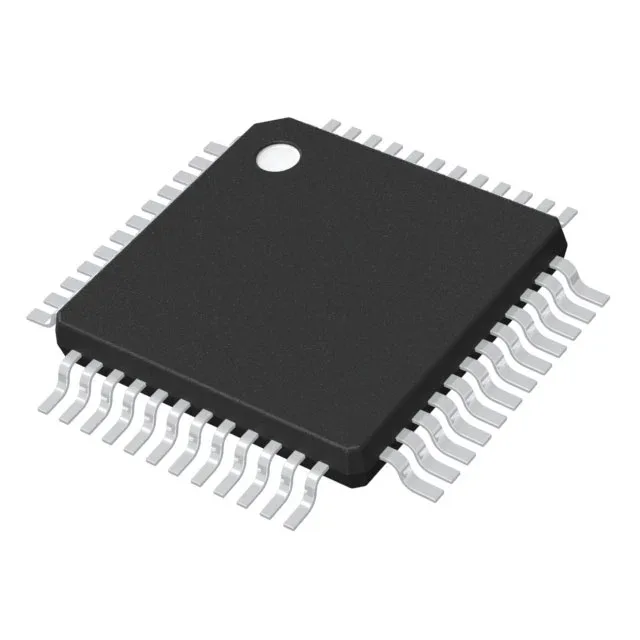
32 KB Flash — sizing the firmware budget
32 KB of Flash is the mid-range density for the STM32F334 value line. That is enough for a moderate control loop with a bootloader, CANopen stack, and sensor calibration tables, but it rules out large embedded GUI or complex RTOS with multiple protocol stacks. If your application needs more code space, the STM32F334 family scales up to 64 KB and 128 KB Flash in the same 48-LQFP footprint — the higher-density parts are pin-compatible, so you can prototype with the C6T7 and migrate without a board spin. The 12 KB SRAM is tight for large data buffers; plan for DMA-driven peripheral transfers to avoid copying through the core.
ST continues to manufacture the STM32F3 series, and the supply channel is mature — no allocation pressure at the time of writing, though that can shift.
48-LQFP 7x7 mm — board area and routing
The 37 I/O lines include up to 15 ADC inputs and 3 DAC outputs, so the analog and digital signal routing can share the same side of the package. The exposed paddle is not present on this LQFP variant — thermal dissipation relies on the leadframe and the PCB copper pour. Supply range is 2.0 V to 3.6 V, which allows a single 3.3 V rail or a 3.0 V Li-ion battery direct connection.
Peripheral set — what the DMA and timer array enable
The PWM timers are the key differentiator for digital-power control — they support dead-time insertion, complementary outputs, and break input for fault handling. The 15-channel 12-bit ADC can be triggered by the timers directly, eliminating CPU intervention for current-sensing in a motor phase. The three 12-bit DACs provide analog set-points or reference voltages without an external DAC IC.
With an active lifecycle and no allocation flags on the STM32F3 series, lead times are generally within standard semiconductor industry ranges — but the exact number depends on the batch size and the distributor's inventory at the moment of inquiry. If your BOM line is time-sensitive, the pin-compatible STM32F334C6T6 (0°C to 70°C) is an alternative that shares the same Flash density and footprint, though you trade the extended temperature range.