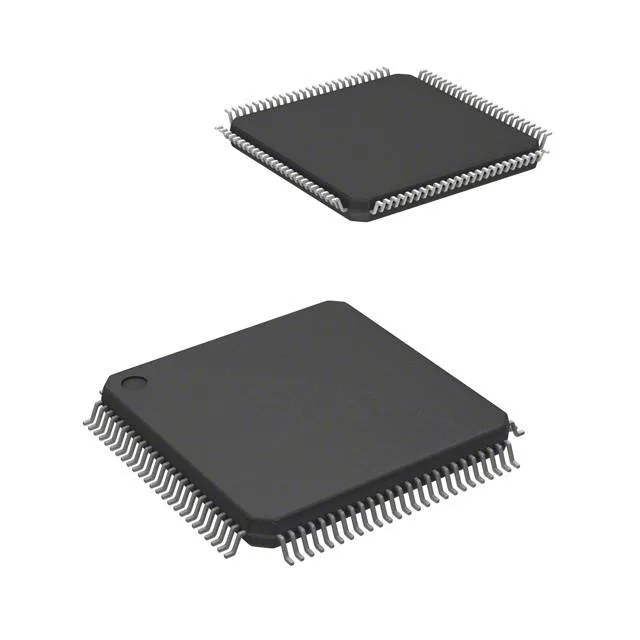
STMicroelectronics STM32F303VET7 — Microcontrollers & Processors (MCU / MPU / DSP)

STM32F303VET7 STMicroelectronics ARM Cortex-M4 MCU, 72MHz

MPNSTM32F303VET7
Active

STMicroelectronics STM32F3 series STM32F303VET7, ARM Cortex-M4, 32-bit Single-Core, 72MHz, 512KB Flash, 80K x 8 RAM, 100-LQFP, -40°C~105°C.

$12.0200Ref. price · indicative, final on quote
Independent supplier — new & surplus stockAuthenticity-screened · ESD-safe packingListing updated Jul 2026

Specifications

STM32F303VET7 specifications
ParameterValue
SeriesSTM32F3
MountingSurface Mount
Oscillator typeInternal
Program memory typeFLASH
Voltage - supply (Vcc (Vdd))2V ~ 3.6V
Operating temperature-40°C~105°C(TA)
Speed72MHz
PackageTray
RAM size80K x 8
Core size32-Bit Single-Core
PeripheralsDMA, I²S, POR, PWM, WDT
ConnectivityCANbus, I²C, IrDA, LINbus, SPI, UART/USART, USB
Number of i (O)86
Core processorARM® Cortex®-M4
Case100-LQFP
Data convertersA/D 39x12b; D/A 2x12b
Program memory size512KB (512K x 8)

Product details

The STM32F303VET7: This core architecture is built for real-time motor control, digital power conversion, and sensor fusion applications where the math throughput of a Cortex-M4 beats a Cortex-M3 on FOC or IIR filter loops without an external DSP. The 80 KB SRAM is organized as 80K x 8 bits, which maps to a single 80 KB block; watch the linker script if you split it between code and data sections. The part integrates 39 analog-to-digital converter channels at 12-bit resolution and two 12-bit digital-to-analog converters.

Connectivity and peripherals — what is on the bus

The CAN controller is the bxCAN type, compatible with CAN 2.0 A/B — no CAN-FD on this part, so plan accordingly if your next-gen network requires it.

Frequently asked questions

What are the differences between STM32F303VET7 and STM32F303VET6?

The primary difference is the temperature grade. Both share the same 100-LQFP package, 512 KB Flash, 80 KB SRAM, and 72 MHz Cortex-M4 core. The 'T7' suffix indicates the extended temperature range and tray packaging; the 'T6' suffix is the standard temperature range. Pin-compatible, so a BOM swap between the two is straightforward if the thermal requirements align.