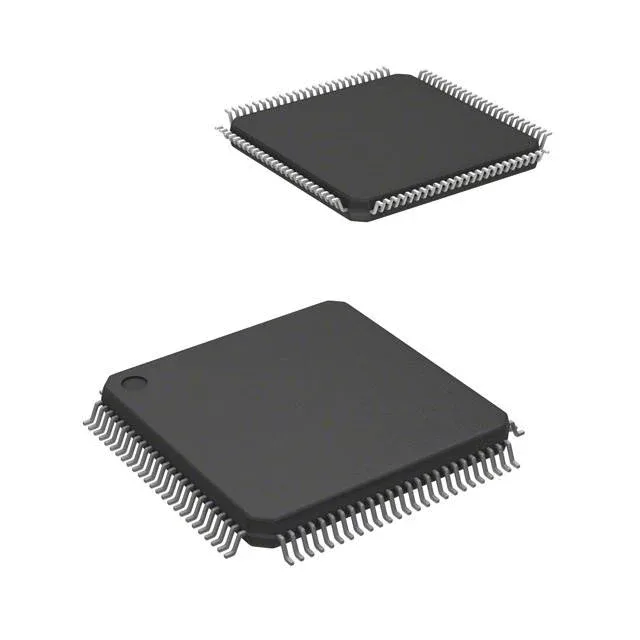
STMicroelectronics STM32F303VET6TR — Microcontrollers & Processors (MCU / MPU / DSP)

STM32F303VET6TR STM32F3 ARM Cortex-M4 MCU, 512KB Flash

MPNSTM32F303VET6TR
Active

STMicroelectronics STM32F303 series, ARM Cortex-M4, 32-bit, 72MHz, 512KB Flash, 80K x 8 RAM, 100-LQFP, -40°C to 85°C.

$12.7300Ref. price · indicative, final on quote
Packaging100-LQFP
RoHSROHS3 Compliant
SeriesSTM32F3
Independent supplier — new & surplus stockAuthenticity-screened · ESD-safe packingListing updated Aug 2026

Specifications

STM32F303VET6TR specifications
ParameterValue
SeriesSTM32F3
MountingSurface Mount
Oscillator typeInternal
Program memory typeFLASH
Voltage - supply (Vcc (Vdd))2V ~ 3.6V
Operating temperature-40°C~85°C(TA)
Speed72MHz
PackageTape & Reel (TR); Cut Tape (CT)
RAM size80K x 8
Core size32-Bit Single-Core
PeripheralsDMA, I²S, POR, PWM, WDT
ConnectivityCANbus, I²C, IrDA, LINbus, SPI, UART/USART, USB
Number of i (O)86
Core processorARM® Cortex®-M4
Case100-LQFP
Data convertersA/D 39x12b; D/A 2x12b
Program memory size512KB (512K x 8)

Product details

What this STM32F303VET6TR brings to a motor-control or digital-power BOM

It sits in the STM32F3 series, which is ST's mixed-signal family built for real-time control applications — motor field-oriented control, digital power conversion, industrial drives, and multi-sensor acquisition. The part is in a 100-pin LQFP package with 86 I/O, giving enough headroom for parallel sensor interfaces and parallel PWM outputs without needing a BGA.

72 MHz Cortex-M4 with FPU — the loop-rate decider

The 72 MHz core speed with a hardware FPU is the headline spec that separates this part from the STM32L1 family. For a motor-control loop running a sensorless FOC observer, the FPU cuts the per-cycle math time roughly in half versus a software-emulated float on a Cortex-M3.

512 KB Flash and 80 KB SRAM — firmware-fit check

512 KB of Flash is the mid-density option in the STM32F303Vx line. It holds a full motor-control stack (FOC library, comms stack, bootloader) with room for OTA staging. The 80 KB SRAM is enough for two 256-point FFT buffers plus control variables; if your application needs a large display frame buffer or a TCP/IP stack with multiple sockets, you will bump into the ceiling and need to look at the STM32F4 or external SRAM.

39-channel 12-bit ADC — analog front-end density

The 39-channel 12-bit ADC is unusually dense for a 100-pin package. It lets you sample three-phase currents, DC-link voltage, and several temperature sensors on a single MCU without external muxes. The two 12-bit DAC channels are useful for analog set-point generation or offset trim in a servo drive.

Package and storage note

The 100-LQFP package has a 14x14 mm body with 0.5 mm pitch — a common footprint that most assembly houses handle without special tooling.

Frequently asked questions

What is the difference between STM32F303VET6 and STM32F303VET6TR?

The STM32F303VET6 and STM32F303VET6TR are the same silicon die and package — the only difference is the shipping medium. The VET6 suffix typically ships in trays or tubes, while the VET6TR suffix ships in Tape & Reel (TR) format for automated assembly lines. The electrical specs, Flash size, RAM, and temperature range are identical.

Is STM32F303VET6TR compatible with STM32F303VCT6?

The STM32F303VET6TR and STM32F303VCT6 share the same 100-LQFP package and pinout, but the VCT6 has 256 KB Flash versus 512 KB on the VET6. If your firmware fits in 256 KB, the VCT6 is a drop-in hardware replacement. If you need the full 512 KB, the VET6 is the correct part.