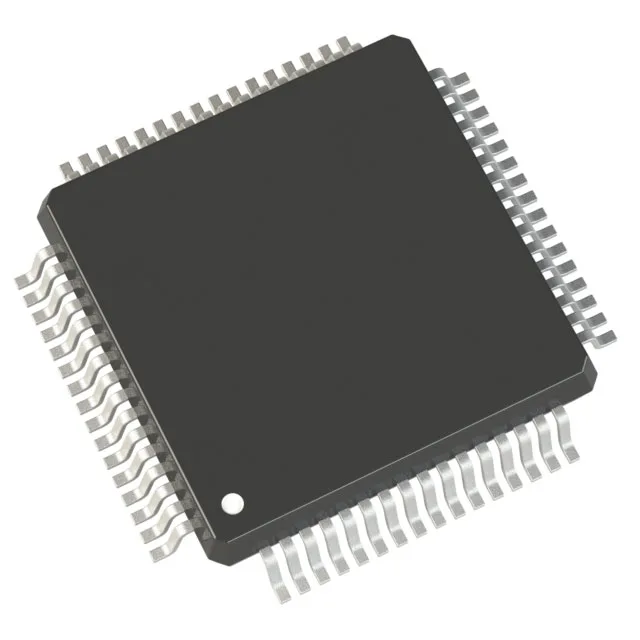
STMicroelectronics STM32F303R8T7 — Microcontrollers & Processors (MCU / MPU / DSP)

STM32F303R8T7 STM32F3 ARM Cortex-M4 MCU, 72 MHz, 64 KB Flash

MPNSTM32F303R8T7
Active

STMicroelectronics STM32F3 series STM32F303R8T7, ARM Cortex-M4, 32-Bit Single-Core MCU, 72MHz, 64KB (64K x 8) FLASH, 12K x 8 RAM, 64-LQFP, -40°C ~ 105°C.

$4.1654Ref. price · indicative, final on quote
Independent supplier — new & surplus stockAuthenticity-screened · ESD-safe packingListing updated Jul 2026

Specifications

STM32F303R8T7 specifications
ParameterValue
SeriesSTM32F3
MountingSurface Mount
Oscillator typeInternal
Program memory typeFLASH
Voltage - supply (Vcc (Vdd))2V ~ 3.6V
Operating temperature-40°C ~ 105°C (TA)
Speed72MHz
PackageTray
RAM size12K x 8
Core size32-Bit Single-Core
PeripheralsDMA, I²S, POR, PWM, WDT
ConnectivityCANbus, I²C, IrDA, LINbus, SPI, UART/USART
Number of i (O)51
Core processorARM® Cortex®-M4
Case64-LQFP
Data convertersA/D 21x12b; D/A 3x12b
Program memory size64KB (64K x 8)

Product details

72 MHz Cortex-M4 with DSP instructions and FPU

The STM32F303R8T7: It packs 64 KB of Flash and 12 KB of SRAM, plus a rich set of analog peripherals: 21-channel 12-bit ADC and three 12-bit DAC channels. The Cortex-M4 core includes a single-precision FPU and DSP instruction set, which offloads math-heavy control loops — think field-oriented motor control or digital power conversion — without an external DSP or FPGA.

The DMA controller keeps data moving without loading the core, critical when the ADC is sampling at high rates or a display buffer is being refreshed via SPI. Integrated I²S supports audio codec interfaces directly. Fifty-one GPIOs in the 64-LQFP package give reasonable headroom for a mixed-signal board with parallel LCD, keypad matrix, and several encoder inputs. The internal oscillator trims to within 1% accuracy, saving the external crystal cost in non-timing-critical applications.

STMicroelectronics lists the STM32F303R8T7 as Active. There is no announced last-time-buy, no PCN for obsolescence, and no successor mandated. The base product number STM32F303 covers multiple Flash/RAM density variants in the same 64-LQFP footprint, so a future firmware growth path exists without a board respin — just swap to the STM32F303RCT7 (256 KB Flash) if the code outgrows 64 KB.

Frequently asked questions

Where can I buy STM32F303R8T7 with available via RFQ confirmation now?

Submit a request and we will check current availability across our supplier network — pricing and lead time confirmed at quote time, not from a static shelf count.

Is STM32F303R8T7 compatible with STM32F303R8T6?

Yes, the STM32F303R8T7 is pin-compatible and functionally identical to the STM32F303R8T6. If your design already runs the T6 variant, the T7 drops in without a board change and adds thermal headroom.

What is the recommended replacement if STM32F303R8T7 goes EOL?

No replacement is currently recommended because the part is Active and has no EOL notice. If a future EOL occurs, the STM32F303 family includes higher-density Flash variants (e.g., STM32F303RCT7 with 256 KB Flash) in the same 64-LQFP footprint, providing a natural migration path without a PCB change.

What development tools and debuggers support STM32F303R8T7?

Standard ARM Cortex-M debug tools work: ST-Link (included on ST's Nucleo and Discovery boards), J-Link from Segger, and any CMSIS-DAP probe. The SWD interface uses the usual 4-pin header (SWDIO, SWCLK, GND, VCC). STM32CubeIDE and Keil MDK provide full project templates for the STM32F303 series.