On the analog side you get nine 12-bit ADC channels and three 12-bit DAC outputs, which means you can sample phase currents and voltage references without an external signal-chain IC.
With 32 KB of program memory and 16 KB of SRAM, this MCU fits firmware for a single-axis field-oriented-control (FOC) motor drive or a compact sensor hub aggregating three analog inputs and one CAN bus message queue. If your application needs over-the-air update staging or a larger lookup table, the pin-compatible STM32F303K8T6 doubles the Flash to 64 KB while keeping the same 32-LQFP footprint — a straightforward BOM swap without a board spin.
Analog density — nine ADC channels and three DACs on a 32-pin package
The 9x12-bit ADC array and 3x12-bit DAC converters are the standout feature for a 32-pin MCU. You can simultaneously sample three phase currents in a motor drive while the DAC outputs generate analog reference or offset voltages. The 12-bit resolution is adequate for 0.1% accuracy on a 3.3 V reference — typical for industrial sensor conditioning. Just budget for a clean analog ground plane and separate Vref+ pin decoupling to keep the ADC noise floor below 1 LSB.
Connectivity — CAN bus and serial interfaces for the factory floor
The CAN interface is what sets it apart from the STM32F0 value line; if your design talks to a fieldbus backbone or an automotive ECU, this part saves an external CAN transceiver. The 25 available I/O pins are enough for a handful of sensors, a small keypad, and a status LED bank, but you'll need to mux if you want a parallel LCD or a full 8-bit data bus.
Package and temperature grade — 32-LQFP at 7x7 mm, industrial range
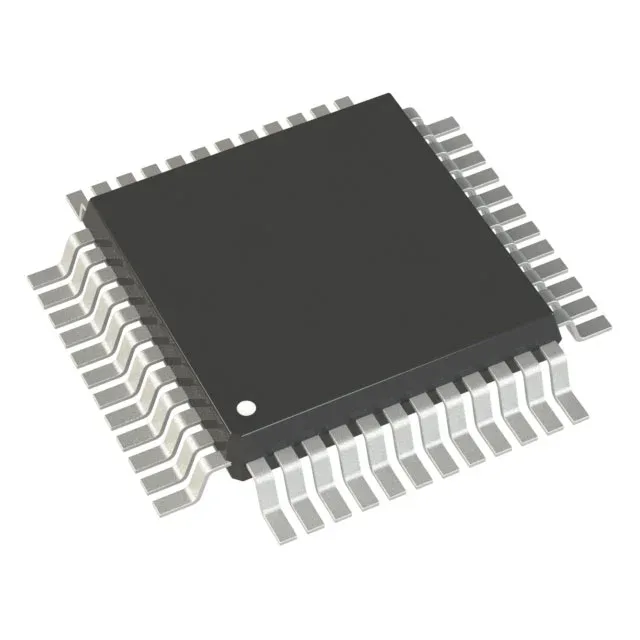
Housed in a 32-LQFP (7x7 mm) package with a 0.8 mm pitch, this MCU is hand-solderable in a rework station and fits on two-layer boards without micro-vias. ROHS3 compliant per the listing, so it passes EU material restrictions without an exemption.