The 72 MHz core clock, combined with the Cortex-M4's single-cycle MAC and hardware divide, lets this MCU execute a 16-bit PID loop with feedforward in under 2 µs. That matters for motor-drive or power-converter designs where the control-law update rate directly sets the bandwidth. The FPU handles floating-point math without software emulation, so you can keep sensor-calibration coefficients in native float without burning cycles on fixed-point scaling.
CANbus and USB on one chip
This MCU integrates both CANbus and USB interfaces, which is a practical combination for industrial equipment that talks to a fieldbus (CANopen, J1939) and also connects to a PC for configuration or data logging. The USB peripheral is device-only, so you need an external PHY for host mode. The CAN controller is standard 2.0 A/B, with two mailboxes per message buffer — enough for most sensor-actuator nodes. If your design needs two CAN ports, look at the STM32F303 series, which adds a second CAN controller on some variants.
100-LQFP package — rework and layout notes
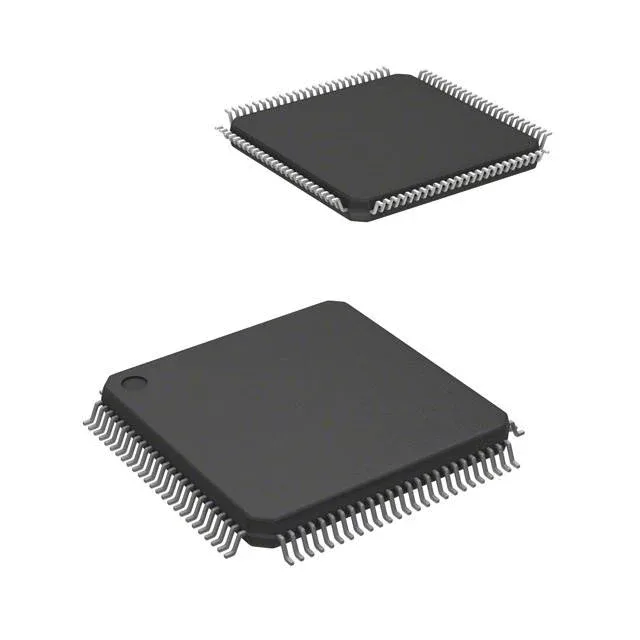
The 100-LQFP (14x14 mm) is a fine-pitch QFP with 0.5 mm lead pitch. The package has no exposed pad, so all thermal dissipation goes through the leads; for continuous operation above 85 °C ambient, check the junction-to-ambient thermal resistance (θJA) in the datasheet against your power budget.