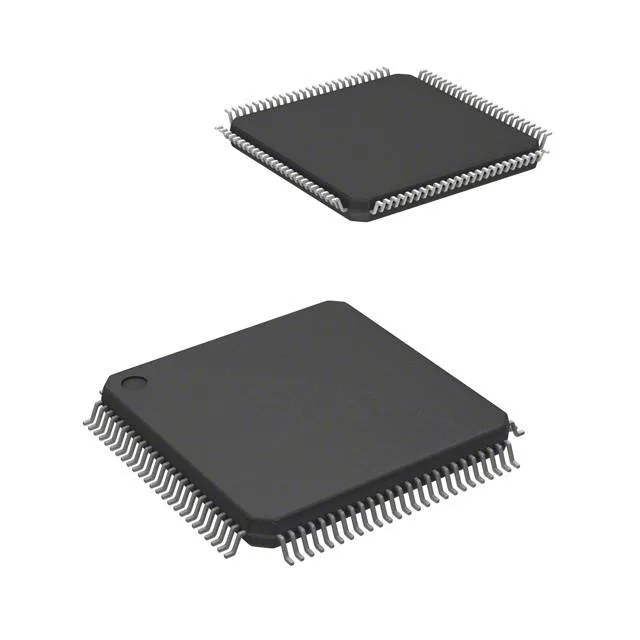
72 MHz Cortex-M4 with DSP and FPU — what it means for control loops
This core architecture handles real-time motor-control FOC loops, digital power conversion, and sensor fusion algorithms without an external DSP or co-processor. The 128 KB Flash (128K x 8) and 32 KB SRAM (32K x 8) provide enough code space and data buffer for mid-complexity embedded control firmware, including OTA staging if wear-leveled. The internal oscillator trims the BOM by one external crystal for less timing-critical applications.
128 KB Flash + 32 KB SRAM — sizing the firmware and data budget
The 128 KB Flash program memory is sized for a moderate-complexity firmware image: a real-time OS kernel, communication stacks (CANopen, USB CDC, Modbus), and application logic typically fit within 80–100 KB, leaving headroom for field updates. The 32 KB SRAM supports two 16 KB ping-pong buffers for ADC data or USB endpoints, plus a 4 KB stack and heap for dynamic allocation. If the application requires larger data arrays or double-buffered graphics, step up to the STM32F303 series with 48 KB SRAM.
Analog integration: 17-channel 12-bit ADC and 12-bit DAC
The 17-channel 12-bit successive-approximation ADC (A/D 17x12b) samples at up to 1 MSps, enough for three-phase current sensing in a motor drive with synchronous sampling. The single 12-bit DAC (D/A 1x12b) can generate analog setpoints or compensate sensor offsets without an external converter.
No end-of-life notices or last-time-buy windows are in effect. The ROHS3 compliance covers current regulatory requirements for EU and global markets. For dual-sourcing resilience, the STM32L151CBU6A (Cortex-M3, 32 MHz, 1.8 V supply) is a different power/performance tier — not a pin-compatible alternate — so maintain the STM32F302VBT6TR as the primary BOM line item.