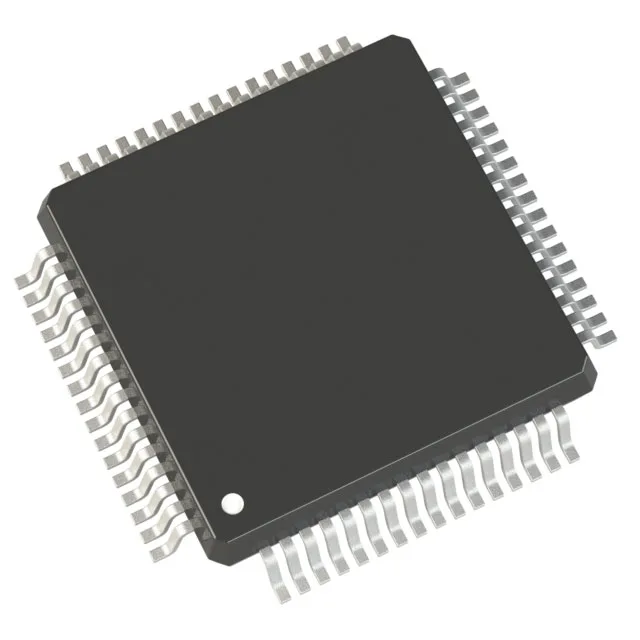
STMicroelectronics STM32F302RET7 — Microcontrollers & Processors (MCU / MPU / DSP)

STM32F302RET7 STM32F3 ARM Cortex-M4 MCU, 72 MHz

MPNSTM32F302RET7
Active

STMicroelectronics STM32F3 series, STM32F302RET7, 32-bit ARM Cortex-M4 single-core MCU, 72 MHz, 512 KB FLASH, 64K x 8 RAM, CANbus/I²C/SPI/UART/USART/USB, 51 I/O, 64-LQFP (10x10), -40 to 105°C.

$6.1692Ref. price · indicative, final on quote
Independent supplier — new & surplus stockAuthenticity-screened · ESD-safe packingListing updated Jul 2026

Specifications

STM32F302RET7 specifications
ParameterValue
SeriesSTM32F3
MountingSurface Mount
Oscillator typeInternal
Program memory typeFLASH
Voltage - supply (Vcc (Vdd))2V ~ 3.6V
Operating temperature-40°C ~ 105°C (TA)
Speed72MHz
PackageTray
RAM size64K x 8
Core size32-Bit Single-Core
PeripheralsDMA, I²S, POR, PWM, WDT
ConnectivityCANbus, I²C, IrDA, LINbus, SPI, UART/USART, USB
Number of i (O)51
Core processorARM® Cortex®-M4
Case64-LQFP
Data convertersA/D 16x12b; D/A 1x12b
Program memory size512KB (512K x 8)

Product details

512 KB Flash, 64 KB SRAM — memory budget for mixed-signal control

Its core runs at 72 MHz, with a single-cycle multiply and hardware divide, plus a single-precision FPU and DSP instructions for sensor fusion or motor-control loops. Program memory is 512 KB of Flash, backed by 64 KB SRAM — enough headroom for a Modbus stack, a USB CDC virtual COM port, and a 1 kHz current-control ISR without overflow into external memory.

Peripheral set — CAN, USB, and multiple serial buses on one die

Package and mounting — 64-LQFP, 10x10 mm body

Housed in a 64-LQFP with a 10x10 mm body and 0.5 mm pitch, this part reflows on standard FR-4 with a single-sided placement pass. The exposed pad is not present on this package variant — thermal dissipation relies on the leadframe and copper pours under the body. Surface-mount assembly is straightforward for any line equipped for 0.5 mm pitch QFPs.

Frequently asked questions

Is STM32F302RET7 compatible with STM32F302CCT6?

Both parts share the same STM32F302 core and peripheral architecture, but they differ in package and memory density. They are not pin-compatible due to the different pin counts, but code written for one can be ported to the other with linker script and pin-mapping adjustments.