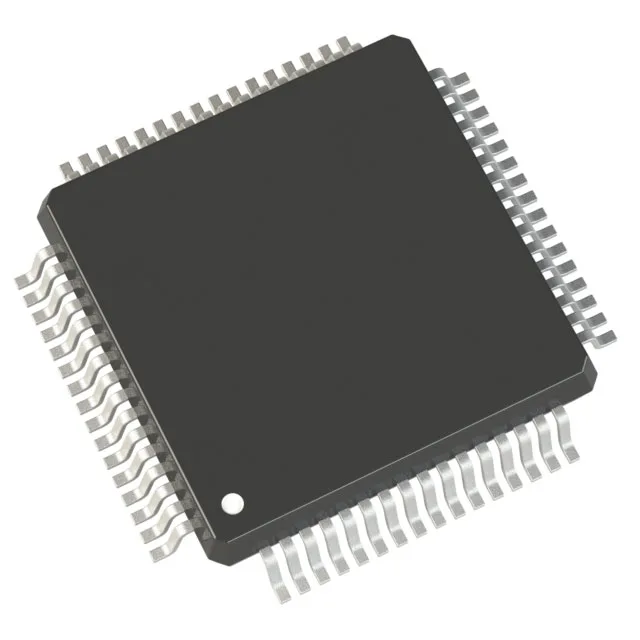
STMicroelectronics STM32F302RDT6TR — Microcontrollers & Processors (MCU / MPU / DSP)

STM32F302RDT6TR STM32F3 ARM Cortex-M4 MCU, 72 MHz

MPNSTM32F302RDT6TR
Active

ST STM32F3 series 32-bit ARM Cortex-M4 MCU, STM32F302RDT6TR, 72 MHz core, 384 KB Flash, 64 KB SRAM, 51 I/O, 2V–3.6V supply, -40°C to 85°C, 64-LQFP.

$5.0655Ref. price · indicative, final on quote
Independent supplier — new & surplus stockAuthenticity-screened · ESD-safe packingListing updated Jul 2026

Specifications

STM32F302RDT6TR specifications
ParameterValue
SeriesSTM32F3
MountingSurface Mount
Oscillator typeInternal
Program memory typeFLASH
Voltage - supply (Vcc (Vdd))2V ~ 3.6V
Operating temperature-40°C ~ 85°C (TA)
Speed72MHz
PackageTape & Reel (TR)
RAM size64K x 8
Core size32-Bit Single-Core
PeripheralsDMA, I²S, POR, PWM, WDT
ConnectivityCANbus, I²C, IrDA, LINbus, SPI, UART/USART, USB
Number of i (O)51
Core processorARM® Cortex®-M4
Case64-LQFP
Data convertersA/D 16x12b; D/A 1x12b
Program memory size384KB (384K x 8)

Product details

The 72 MHz core clock with the Cortex-M4 FPU lets this part handle sensor fusion, motor-control algorithms, or digital power loops that need floating-point arithmetic without cycle-counting. The 384 KB Flash gives room for a moderate firmware image plus an OTA staging buffer; the 64 KB SRAM supports several real-time data buffers and a modest stack. If your application needs more working memory, the STM32F3 family offers density upgrades, but for a typical mixed-signal control board — say, a three-phase motor drive with current sensing — this memory split is well matched.

I/O and peripheral set for board-level connectivity

With 51 I/O lines, the STM32F302RDT6TR can connect to multiple external sensors, actuators, and displays. The 16-channel 12-bit ADC and single 12-bit DAC cover analog front-end needs without an external converter. The internal oscillator reduces BOM count, though an external crystal can be added for tighter timing.

Package and supply: 64-LQFP, 2V to 3.6V

Housed in a 64-LQFP package (10x10 mm body), the part is a surface-mount device that reflows on standard lead-free profiles. The supply range of 2V to 3.6V lets it run from a 3.3V rail or a 2.5V rail, and it can tolerate a 3.6V absolute maximum. The 64-LQFP footprint is common across many STM32F3 variants, so a layout can often accommodate a pin-compatible upgrade or second source without a board spin.

Frequently asked questions

What is the difference between STM32F302RDT6 and STM32F302RDT6TR?

The two parts are electrically identical. The STM32F302RDT6TR is the Tape & Reel (TR) packaging option for automated pick-and-place assembly, while the STM32F302RDT6 ships in tray or tube. The silicon and firmware are the same.

What are the equivalent or replacement parts for STM32F302RDT6TR?

Pin-compatible siblings within the STM32F302 base product number (same 64-LQFP footprint) offer different Flash and SRAM densities. For a direct replacement with identical memory, the STM32F302RDT6 (tray) is the same die. For a density upgrade, the STM32F302RCT6 or STM32F302RET6 share the same pinout.

How to program STM32F302RDT6TR?

The device is programmed via the Serial Wire Debug (SWD) interface using a standard ST-Link or J-Link debug probe. ST's STM32CubeProgrammer or any ARM-compatible IDE (Keil, IAR, STM32CubeIDE) can flash the 384 KB internal Flash. The bootloader also supports UART and USB DFU for field updates.

Is STM32F302RDT6TR RoHS compliant?

Yes, the STM32F302RDT6TR is RoHS compliant. The 64-LQFP package is lead-free and compatible with lead-free reflow profiles.