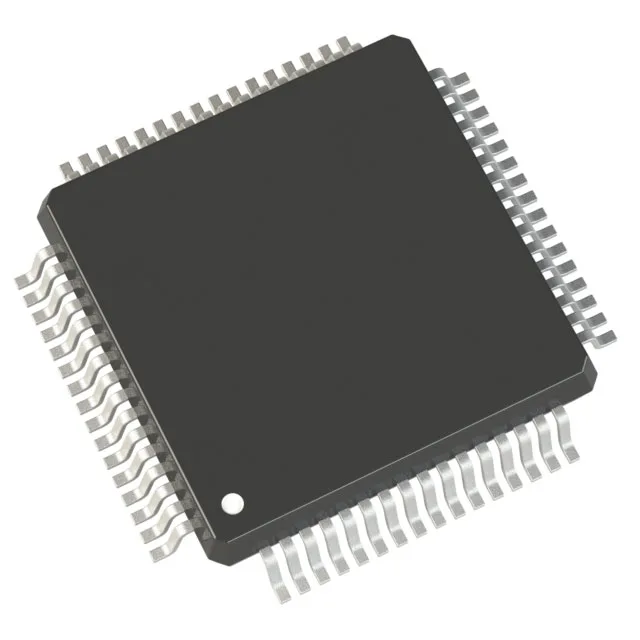
The STM32F302RDT6: It runs at up to 72 MHz and packs 384 KB of Flash program memory alongside 64 KB of SRAM (64K x 8). The 64-LQFP (10x10 mm) package gives you 51 general-purpose I/O pins, which is enough for a motor-drive interface with encoder feedback, a CAN transceiver, and a USB connection without multiplexing.
The STM32F302RDT6 includes a USB interface, CANbus, SPI, I²C, UART/USART, IrDA, and LINbus — enough to talk to a CANopen motor drive, log data over USB to a host PC, and read an I²C temperature sensor on the same chip. The 12-bit ADC has 16 multiplexed channels; there is also a single 12-bit DAC. Internal oscillator means you can skip the external crystal for many applications, though the datasheet's clock-tree note recommends checking USB jitter tolerance if you run the PLL from the internal RC. For firmware bring-up, the SWD debug port stays alive even with the watchdog armed, and the boot from internal Flash works with BOOT0 strapped low. The 72 MHz PLL needs one Flash wait state set before raising the core clock above 48 MHz, or the first branch instruction hard-faults.
The exposed pad (if present on this variant) should be stitched to ground with thermal vias to keep the junction temperature in check when running the core and peripherals at full load.
This is an active STM32 part with a broad distribution footprint. It crosses to the same 64-LQFP footprint as other STM32F302 density options, so you can dual-source across the series without a board spin.