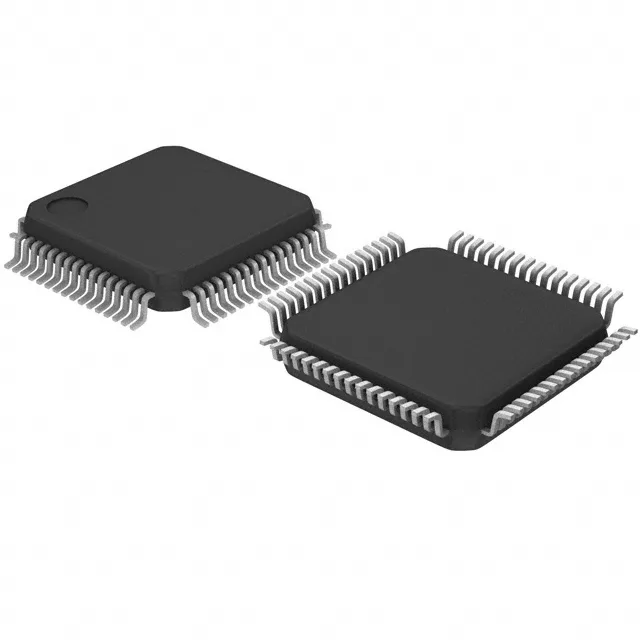
STMicroelectronics STM32F301R8T6 — Microcontrollers & Processors (MCU / MPU / DSP)

STM32F301R8T6 STM32F3 ARM Cortex-M4 MCU, 72 MHz, 64 KB Flash

MPNSTM32F301R8T6
Active

STMicroelectronics STM32F3 series, ARM Cortex-M4 32-bit MCU, 72 MHz, 64 KB Flash, 16K x 8 RAM, 51 I/O, I²C, IrDA, LINbus, SPI, UART/USART, 2V to 3.6V, -40°C to 85°C, 64-LQFP (10x10 mm).

$6.0800Ref. price · indicative, final on quote
Packaging64-LQFP
RoHSROHS3 Compliant
SeriesSTM32F3
Independent supplier — new & surplus stockAuthenticity-screened · ESD-safe packingListing updated Aug 2026

Specifications

STM32F301R8T6 specifications
ParameterValue
SeriesSTM32F3
MountingSurface Mount
Oscillator typeInternal
Program memory typeFLASH
Voltage - supply (Vcc (Vdd))2V ~ 3.6V
Operating temperature-40°C ~ 85°C (TA)
Speed72MHz
PackageTray
RAM size16K x 8
Core size32-Bit Single-Core
PeripheralsDMA, I²S, POR, PWM, WDT
ConnectivityI²C, IrDA, LINbus, SPI, UART/USART
Number of i (O)51
Core processorARM® Cortex®-M4
Case64-LQFP
Data convertersA/D 15x12b; D/A 1x12b
Program memory size64KB (64K x 8)

Product details

72 MHz Cortex-M4 with DSP and FPU — what the core speed means for control loops

The STM32F301R8T6 runs at 72 MHz with a Cortex-M4 core.

Analog peripherals: 15-channel 12-bit ADC and one 12-bit DAC

Operating from 2V to 3.6V, the MCU runs directly from a 3.3V rail or a 3.6V Li-ion cell near full charge. The wide Vcc tolerance also helps when the supply is a simple LDO with ±5% tolerance — no need for a separate buck converter.

Package and footprint: 64-LQFP (10x10 mm)

The 51 I/O give enough GPIO for parallel LCD data buses, multiple UARTs, or a bank of sensor interrupts. The LQFP is rework-friendly — no BGA underfill or X-ray inspection needed.

Frequently asked questions

What is the flash size of STM32F301R8T6?

The program memory is 64 KB of Flash (64K x 8). That is enough for moderate-complexity firmware such as motor control or sensor fusion, but not for a full GUI stack or large bootloader plus application.

STM32F301R8T6 vs STM32F303R8T6 — what is the difference?

The STM32F303R8T6 is a higher-end sibling in the same STM32F3 family. While both share the Cortex-M4 core and 72 MHz clock, the F303 typically adds more analog peripherals (e.g., multiple 12-bit DACs, higher-resolution timers) and a larger SRAM option. The F301R8T6 is the cost-optimized entry point with a single DAC and 16 KB SRAM. For designs that need only one analog output and moderate buffer space, the F301 saves BOM cost.

Is STM32F301R8T6 compatible with STM32F0 series?

No, the STM32F301R8T6 uses an ARM Cortex-M4 core with DSP and FPU, while the STM32F0 series uses Cortex-M0. The pinout and register maps differ significantly. Code written for an F0 will not run directly on the F301 without porting, and the peripheral sets (timers, ADC, DMA) are not drop-in compatible.