The Cortex-M4 brings a single-cycle MAC and hardware divide, so you can run a PID loop or a simple FFT without a separate DSP — useful for motor drive or power conversion feedback.
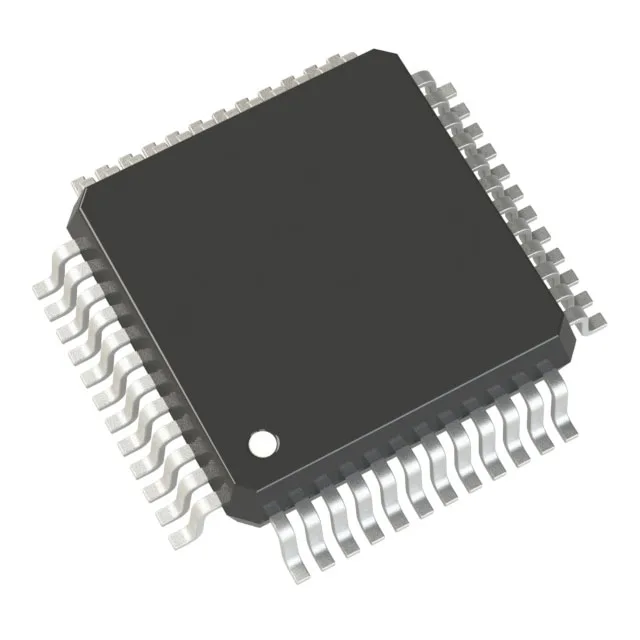
The supply range of 2V to 3.6V lets it run off a single 3.3V rail or a 2-cell alkaline battery pack without a regulator — just watch the brown-out threshold at the low end. The exposed pad is not present on this package variant, so thermal dissipation goes through the leads — keep the copper pour under the part for a bit of heatsinking.
Rework note — 48-LQFP under the hot-air station
Use a tacky flux and a stencil for paste alignment — the 0.5 mm pitch bridges easily if you over-apply.
Peripherals and debug — first-power checklist
The MCU boots from internal Flash with BOOT0 strapped low; the SWD debug port stays alive even with the watchdog enabled, so you can halt and reprogram without a hardware reset. The internal oscillator is accurate enough for UART at 115200 baud, but if you need precise timing for CAN or I²S, plan on an external crystal. DMA is available for peripheral transfers without CPU load — useful for ADC scanning or SPI data streaming.
Lifecycle and supply — active, no LTB risk
The base part number STM32F301 is shared across the density and package variants, so future migration within the family is straightforward.