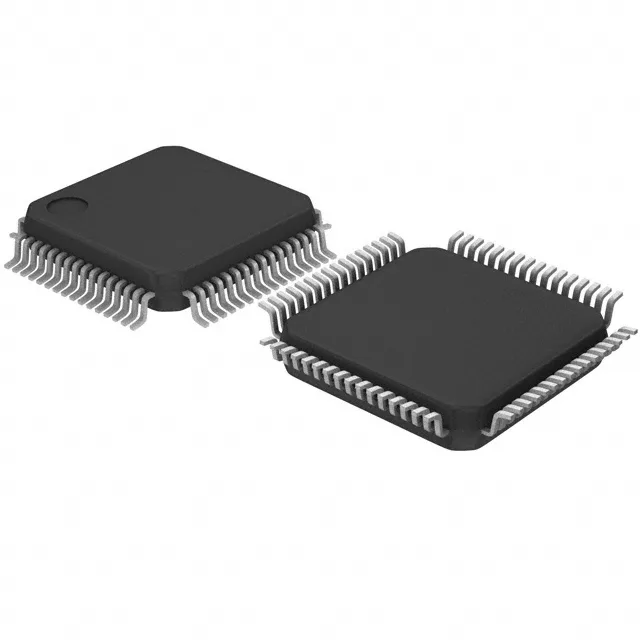
STMicroelectronics STM32F107RCT6 — Microcontrollers & Processors (MCU / MPU / DSP)

STM32F107RCT6 ARM Cortex-M3 MCU, 72 MHz, 256 KB Flash

MPNSTM32F107RCT6
Active

STMicroelectronics STM32F107RCT6, STM32F1 series, 32-bit ARM Cortex-M3 MCU, 72 MHz, 256 KB Flash, 64 KB SRAM, 51 I/O, Ethernet MAC, CAN, USB OTG, 64-LQFP, -40°C to 85°C.

$9.9000Ref. price · indicative, final on quote
Packaging64-LQFP
RoHSROHS3 Compliant
SeriesSTM32F1
Independent supplier — new & surplus stockAuthenticity-screened · ESD-safe packingListing updated Aug 2026

Specifications

STM32F107RCT6 specifications
ParameterValue
SeriesSTM32F1
MountingSurface Mount
Oscillator typeInternal
Program memory typeFLASH
Voltage - supply (Vcc (Vdd))2V ~ 3.6V
Operating temperature-40°C ~ 85°C (TA)
Speed72MHz
PackageTray
RAM size64K x 8
Core size32-Bit Single-Core
PeripheralsDMA, POR, PWM, Voltage Detect, WDT
ConnectivityCANbus, Ethernet, I2C, IrDA, LINbus, SPI, UART/USART, USB OTG
Number of i (O)51
Core processorARM® Cortex®-M3
Case64-LQFP
Data convertersA/D 16x12b; D/A 2x12b
Program memory size256KB (256K x 8)

Product details

The 64-LQFP package gives you 51 I/O, plus a 16-channel 12-bit ADC and a 2-channel 12-bit DAC. This is the part you spec when a design needs both real-time control and wired networking without adding an external PHY controller — the Ethernet MAC talks directly to the core.

Ethernet, CAN, USB OTG — the connectivity that sets it apart

What distinguishes the STM32F107 from the rest of the STM32F1 family is the on-chip Ethernet MAC. It supports MII and RMII interfaces to an external PHY, so you can add 10/100 Ethernet with just a transceiver and magnetics. The two CAN controllers handle industrial fieldbus gateways, and USB OTG lets the MCU act as either host or device — useful for firmware updates over a USB stick or connecting to a sensor hub. The 72 MHz core has enough headroom to run the Ethernet stack, a real-time OS, and application code without bottlenecking, as long as the DMA engine is used for packet buffers.

256 KB Flash, 64 KB SRAM — sizing the firmware and data buffers

The 64 KB SRAM handles packet buffers for Ethernet (typically 16–32 KB for the stack) plus the RTOS and data arrays. If your design streams audio or logs high-rate sensor data, watch the SRAM budget — the 64 KB is adequate for most industrial gateways but tight for video or large circular buffers. The DMA controller offloads peripheral transfers, so the core isn't stalled by memory copies.

If you are already using it in a BOM, the supply channel is stable through authorized and independent distribution. The ROHS3 compliance covers current environmental regulations.

64-LQFP package — layout and rework notes

The 64-LQFP package has a 0.5 mm pitch, which is manageable with standard soldering processes. No exposed pad — all thermal dissipation goes through the leads, so keep the copper pour on the VDD pins generous if the MCU drives multiple peripherals at full speed. The surface-mount footprint is industry-standard; rework with hot air at 260°C peak per J-STD-020.

Frequently asked questions

Does STM32F107RCT6 have Ethernet and what is its performance?

Yes, the STM32F107RCT6 includes an on-chip Ethernet MAC supporting MII and RMII interfaces. The 72 MHz ARM Cortex-M3 core has sufficient throughput to run a TCP/IP stack and application code without external controllers, provided the DMA engine is used for packet buffers.

Is STM32F107RCT6 pin compatible with STM32F107VCT6?

The STM32F107RCT6 comes in a 64-LQFP package, while the STM32F107VCT6 is a 100-pin LQFP variant. They are not pin-compatible due to the different pin counts. The base architecture and peripheral set are the same, but the 100-pin version offers more I/O and possibly additional peripheral instances.

What is the closest replacement for STM32F107RCT6?

Within the STM32F1 Connectivity Line, the STM32F107VCT6 (100-pin, 256 KB Flash) is a higher-I/O sibling. For a lower-power alternative, the STM32L151CBU6A runs at 32 MHz and draws less current, but lacks Ethernet and CAN — so it is not a functional drop-in. There is no pin-compatible second source from another manufacturer; the STM32F107RCT6 is unique in its peripheral set and footprint.