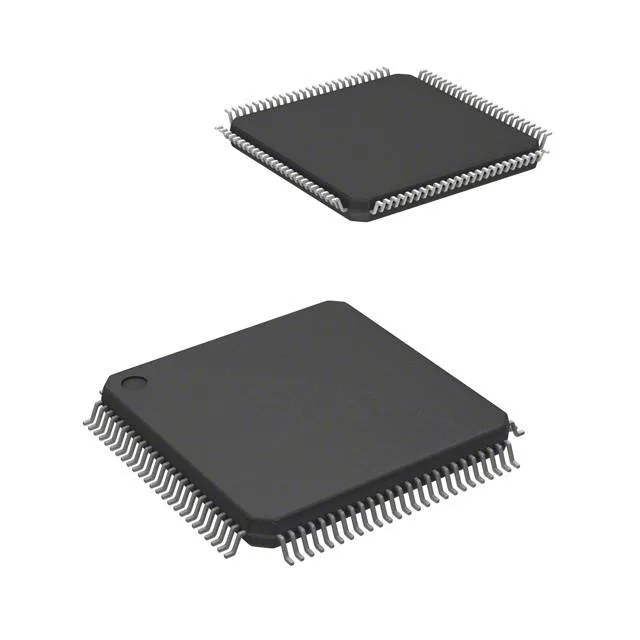
It integrates a rich peripheral set including CANbus, USB OTG, multiple I²C/SPI/UART interfaces, and a 16-channel 12-bit ADC plus two 12-bit DACs. The 100-LQFP package gives you 80 I/O pins, enough for a control panel or a sensor hub.
256 KB of Flash is enough to hold a full RTOS kernel, a TCP/IP stack, and application code for an industrial gateway or a CAN-to-Ethernet bridge. The 64 KB RAM (organized as 64K x 8) handles moderate packet buffers and data arrays without forcing external SRAM. If you are staging OTA firmware updates, the Flash erase granularity (sector size) matters – check the reference manual for the sector map, but the density is comfortable for a single-bank update scheme.
Connectivity mix – CAN, USB OTG, and serial lines
This MCU carries CANbus and USB OTG on the same die, which is uncommon in the 100-pin STM32F1 tier.
ST continues to manufacture the STM32F1 series, and the part is ROHS3 compliant. For dual-sourcing resilience, the STM32L151CBU6A is a functional alternative from the STM32L1 series – same Cortex-M3 core, similar ADC/DAC count, but clocked at 32 MHz and with a lower supply voltage floor of 1.8 V. The series trades speed for ultra-low-power operation, so the swap requires firmware and timing adjustments.
Housed in a 100-LQFP (14x14 mm body), the STM32F105VCT7 is a surface-mount part with 0.5 mm pitch.