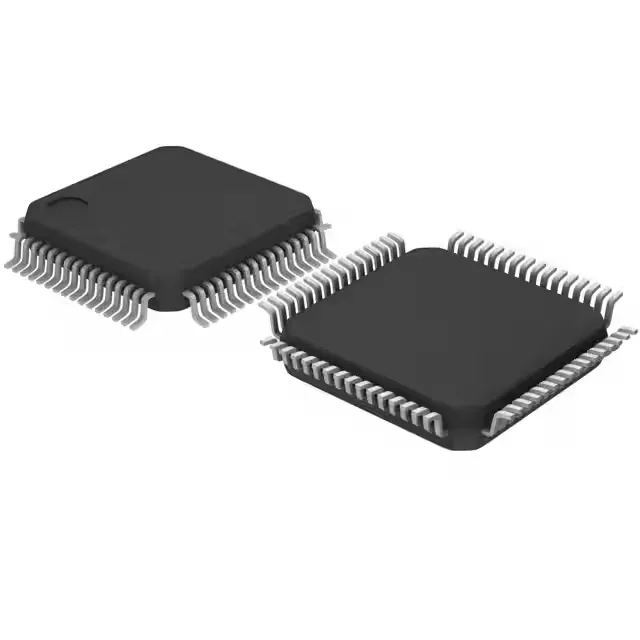
Why the -T7 temperature grade matters for your design
The T7 suffix denotes the industrial temperature range: -40 to 105°C ambient. That is a step above the standard -40 to 85°C commercial parts, and it is what keeps this MCU viable in motor drives where the controller shares a board with IGBTs, in outdoor telecom cabinets that see direct sun, or in engine-bay-adjacent electronics where ambient can push past 85°C. If your BOM currently specifies the STM32F105R8T6 (0 to 70°C commercial range), the T7 is a drop-in upgrade for the same footprint and firmware — no board spin, just wider thermal margin. The T6 is the lower-cost indoor-only variant; the T7 is the one to spec if the product ever leaves a climate-controlled room.
No allocation games on this line — the STM32F105 Connectivity series has been stable for years.
Memory sizing — 64 KB Flash, 64 KB RAM
The Flash is enough for a real-time control stack plus a USB device stack and CANopen protocol layer; the 64 KB RAM gives headroom for double-buffered ADC data or a small RTOS heap without external memory. If your firmware image is already pushing 50 KB with a bootloader, consider stepping up to the STM32F105V8 or the 128 KB Flash variants in the same package — the T7's 64 KB is the entry point, not the ceiling.
Connectivity — USB OTG plus CAN on one chip
The STM32F105 is one of the few STM32F1 parts that integrates a USB OTG full-speed PHY alongside a CAN 2.0B controller. The peripheral set also includes two SPI ports, two I²C interfaces, five USARTs (some with ISO 7816 smartcard support), and an I²S audio interface — enough serial bandwidth to handle a sensor array, a display, and a wireless module simultaneously.