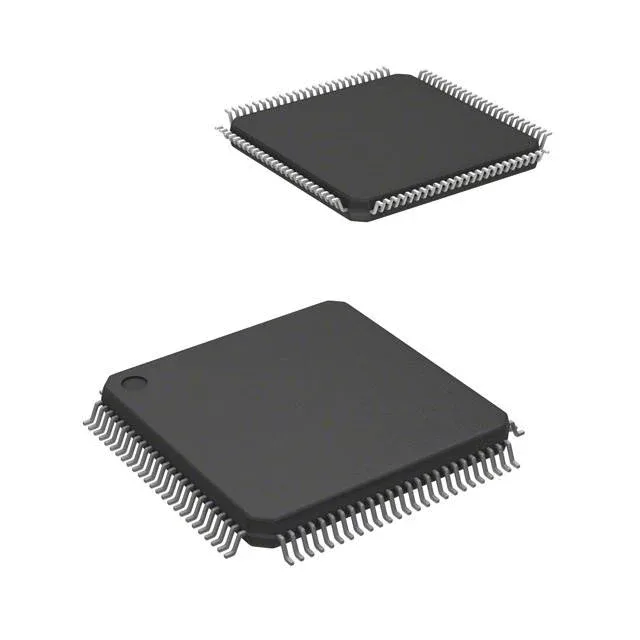
STMicroelectronics STM32F103VBT6 — Microcontrollers & Processors (MCU / MPU / DSP)

STM32F103VBT6 STMicro ARM Cortex-M3 MCU, 72 MHz

MPNSTM32F103VBT6
Active

STMicroelectronics STM32F1 series STM32F103VBT6, ARM Cortex-M3, 32-Bit Single-Core, 72MHz, 128KB Flash, 20K x 8 RAM, 80 I/O, 100-LQFP, -40°C~85°C, 2V ~ 3.6V.

$9.2000Ref. price · indicative, final on quote
Independent supplier — new & surplus stockAuthenticity-screened · ESD-safe packingListing updated Jul 2026

Specifications

STM32F103VBT6 specifications
ParameterValue
SeriesSTM32F1
MountingSurface Mount
Oscillator typeInternal
Program memory typeFLASH
Voltage - supply (Vcc (Vdd))2V ~ 3.6V
Operating temperature-40°C~85°C(TA)
Speed72MHz
PackageTray
RAM size20K x 8
Core size32-Bit Single-Core
PeripheralsDMA, Motor Control PWM, PDR, POR, PVD, PWM, Temp Sensor, WDT
ConnectivityCANbus, I²C, IrDA, LINbus, SPI, UART/USART, USB
Number of i (O)80
Core processorARM® Cortex®-M3
Case100-LQFP
Data convertersA/D 16x12b
Program memory size128KB (128K x 8)

Product details

72 MHz Cortex-M3 with 128 KB Flash — the mid-density workhorse

The 72 MHz core delivers a Dhrystone 1.1 MIPS/MHz throughput typical for the Cortex-M3, so you're looking at roughly 90 DMIPS. That's enough headroom for a field-oriented control loop on a motor, a Modbus RTU stack, and a UI update without thrashing the scheduler.

Peripheral set and connectivity — what's on the bus

The part includes DMA, multiple PWM channels with dead-time insertion for motor control, a temperature sensor, and the usual watchdog and power-on-reset blocks. The 80 general-purpose I/Os are mapped across the 100-LQFP package, giving you plenty of pins for parallel sensor arrays or a parallel LCD data bus without needing a port expander. The 16-channel 12-bit ADC is a single converter with a multiplexer front-end — useful for reading multiple analog signals like current shunts or thermistors, but watch the sampling rate if you need simultaneous conversion on more than one channel.

At 72 MHz the core draws around 50 mA typical from the 3.3 V rail, so a basic 3.3 V LDO rated for 200 mA handles it with margin for the I/O loads.

ST lists this part as Active in production, meaning it's still being manufactured and supported for new designs. For procurement, the active status means multi-year availability through ST's distribution channel and the independent market. If you're looking for a second-source or a pin-compatible upgrade, the STM32F103VCT6 doubles the Flash to 256 KB while keeping the same 100-LQFP footprint and peripheral map — a straightforward BOM swap if your code grows.

Frequently asked questions

What is the difference between STM32F103VBT6 and STM32F103VCT6?

The STM32F103VCT6 doubles the Flash to 256 KB while keeping the same 100-LQFP package, 72 MHz core, 20 KB SRAM, and peripheral set. If your firmware fits in 128 KB, the VBT6 is the cost-optimized choice; if you need more code space for a protocol stack or OTA update buffer, the VCT6 is a drop-in pin-compatible upgrade.

What voltage does the STM32F103VBT6 operate at?

The supply voltage range is 2.0 V to 3.6 V on the VDD pins. The core and I/Os run from the same rail, so a 3.3 V regulator is the typical choice. The internal oscillator and ADC are stable across that range.